Readings Newsletter
Become a Readings Member to make your shopping experience even easier.
Sign in or sign up for free!
You’re not far away from qualifying for FREE standard shipping within Australia
You’ve qualified for FREE standard shipping within Australia
The cart is loading…


This title is printed to order. This book may have been self-published. If so, we cannot guarantee the quality of the content. In the main most books will have gone through the editing process however some may not. We therefore suggest that you be aware of this before ordering this book. If in doubt check either the author or publisher’s details as we are unable to accept any returns unless they are faulty. Please contact us if you have any questions.
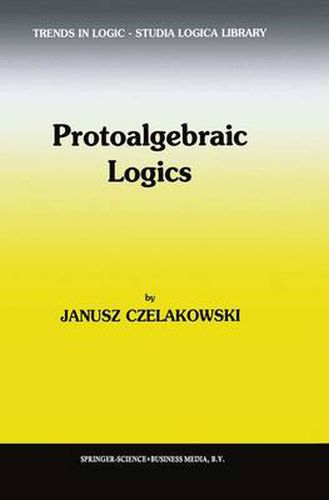
The main aim of this monograph is to provide a structured study of the algebraic method in metalogic. In contrast to traditional algebraic logic, where the focus is on the algebraic forms of specific deductive systems, abstract algebraic logic is concerned with the process of algebraization itself. This book presents in a systematic way recent ideas in abstract algebraic logic centered around the notion of the Leibniz operator. The stress is put on the taxonomy of deductive systems. Isolating a list of plausible properties of the Leibniz operator serves as a basis for distinguishing certain natural classes of sentential logics. The hierarchy of deductive systems presented in the book comprises, among others, the following classes: protoalgebraic logics, equivalential logics, algebraizable logics, and Fregean logics. Because of the intimate connection between algebraic and logical structures, the book also provides a uniform treatment of various topics concerning deduction theorems and quasivarieties of algebras. The presentation of the above classes of logics is accompanied by a wealth of examples illustrating the general theory. An essential part of the book is formed by the numerous exercises integrated into the text. This book is both suitable for logically and algebraically minded graduate and advanced graduate students of mathematics, computer science and philosophy, and as a reference work for the expert.
$9.00 standard shipping within Australia
FREE standard shipping within Australia for orders over $100.00
Express & International shipping calculated at checkout
Stock availability can be subject to change without notice. We recommend calling the shop or contacting our online team to check availability of low stock items. Please see our Shopping Online page for more details.
This title is printed to order. This book may have been self-published. If so, we cannot guarantee the quality of the content. In the main most books will have gone through the editing process however some may not. We therefore suggest that you be aware of this before ordering this book. If in doubt check either the author or publisher’s details as we are unable to accept any returns unless they are faulty. Please contact us if you have any questions.
The main aim of this monograph is to provide a structured study of the algebraic method in metalogic. In contrast to traditional algebraic logic, where the focus is on the algebraic forms of specific deductive systems, abstract algebraic logic is concerned with the process of algebraization itself. This book presents in a systematic way recent ideas in abstract algebraic logic centered around the notion of the Leibniz operator. The stress is put on the taxonomy of deductive systems. Isolating a list of plausible properties of the Leibniz operator serves as a basis for distinguishing certain natural classes of sentential logics. The hierarchy of deductive systems presented in the book comprises, among others, the following classes: protoalgebraic logics, equivalential logics, algebraizable logics, and Fregean logics. Because of the intimate connection between algebraic and logical structures, the book also provides a uniform treatment of various topics concerning deduction theorems and quasivarieties of algebras. The presentation of the above classes of logics is accompanied by a wealth of examples illustrating the general theory. An essential part of the book is formed by the numerous exercises integrated into the text. This book is both suitable for logically and algebraically minded graduate and advanced graduate students of mathematics, computer science and philosophy, and as a reference work for the expert.
Search our extensive online catalogue.
