Readings Newsletter
Become a Readings Member to make your shopping experience even easier.
Sign in or sign up for free!
You’re not far away from qualifying for FREE standard shipping within Australia
You’ve qualified for FREE standard shipping within Australia
The cart is loading…


This title is printed to order. This book may have been self-published. If so, we cannot guarantee the quality of the content. In the main most books will have gone through the editing process however some may not. We therefore suggest that you be aware of this before ordering this book. If in doubt check either the author or publisher’s details as we are unable to accept any returns unless they are faulty. Please contact us if you have any questions.
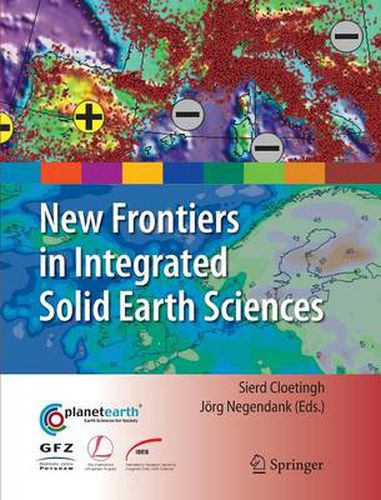
Man’s intensifying use of the Earth’s habitat has led to an urgent need for scientifically advanced ‘geo-prediction systems’ that accurately locate subsurface resources and forecast the timing and magnitude of earthquakes, volcanic eruptions and land subsidence.
As advances in the earth sciences lead to process-oriented ways of modeling the complex processes in the solid Earth, the papers in this volume provide a survey of some recent developments at the leading edge of this highly technical discipline. The chapters cover current research in predicting the future behavior of geologic systems as well as the mapping of geologic patterns that exist now in the subsurface as frozen evidence of the past. Both techniques are highly relevant to humanity’s need for resources such as water, and will also help us control environmental degradation.
The book also discusses advances made in seismological methods to obtain information on the 3D structure of the mantle and the lithosphere, and in the quantitative understanding of lithospheric scale processes. It covers recent breakthroughs in 3D seismic imaging that have enhanced the spatial resolution of these structural processes, and the move towards 4D imaging that measures these processes over time.
The new frontier in modern Earth sciences described in this book has major implications for oceanographic and atmospheric sciences and our understanding of climate variability. It brings readers right up to date with the research in this vital field.
$9.00 standard shipping within Australia
FREE standard shipping within Australia for orders over $100.00
Express & International shipping calculated at checkout
Stock availability can be subject to change without notice. We recommend calling the shop or contacting our online team to check availability of low stock items. Please see our Shopping Online page for more details.
This title is printed to order. This book may have been self-published. If so, we cannot guarantee the quality of the content. In the main most books will have gone through the editing process however some may not. We therefore suggest that you be aware of this before ordering this book. If in doubt check either the author or publisher’s details as we are unable to accept any returns unless they are faulty. Please contact us if you have any questions.
Man’s intensifying use of the Earth’s habitat has led to an urgent need for scientifically advanced ‘geo-prediction systems’ that accurately locate subsurface resources and forecast the timing and magnitude of earthquakes, volcanic eruptions and land subsidence.
As advances in the earth sciences lead to process-oriented ways of modeling the complex processes in the solid Earth, the papers in this volume provide a survey of some recent developments at the leading edge of this highly technical discipline. The chapters cover current research in predicting the future behavior of geologic systems as well as the mapping of geologic patterns that exist now in the subsurface as frozen evidence of the past. Both techniques are highly relevant to humanity’s need for resources such as water, and will also help us control environmental degradation.
The book also discusses advances made in seismological methods to obtain information on the 3D structure of the mantle and the lithosphere, and in the quantitative understanding of lithospheric scale processes. It covers recent breakthroughs in 3D seismic imaging that have enhanced the spatial resolution of these structural processes, and the move towards 4D imaging that measures these processes over time.
The new frontier in modern Earth sciences described in this book has major implications for oceanographic and atmospheric sciences and our understanding of climate variability. It brings readers right up to date with the research in this vital field.
Search our extensive online catalogue.
