Readings Newsletter
Become a Readings Member to make your shopping experience even easier.
Sign in or sign up for free!
You’re not far away from qualifying for FREE standard shipping within Australia
You’ve qualified for FREE standard shipping within Australia
The cart is loading…


This title is printed to order. This book may have been self-published. If so, we cannot guarantee the quality of the content. In the main most books will have gone through the editing process however some may not. We therefore suggest that you be aware of this before ordering this book. If in doubt check either the author or publisher’s details as we are unable to accept any returns unless they are faulty. Please contact us if you have any questions.
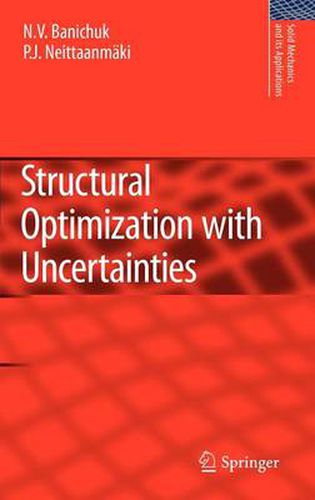
Structural optimization is currently attracting considerable attention. Interest in - search in optimal design has grown in connection with the rapid development of aeronautical and space technologies, shipbuilding, and design of precision mach- ery. A special ?eld in these investigations is devoted to structural optimization with incomplete information (incomplete data). The importance of these investigations is explained as follows. The conventional theory of optimal structural design - sumes precise knowledge of material parameters, including damage characteristics and loadings applied to the structure. In practice such precise knowledge is seldom available. Thus, it is important to be able to predict the sensitivity of a designed structure to random ?uctuations in the environment and to variations in the material properties. To design reliable structures it is necessary to apply the so-called gu- anteed approach, based on a worst case scenario or a more optimistic probabilistic approach, if we have additional statistical data. Problems of optimal design with incomplete information also have consid- able theoretical importance. The introduction and investigations into new types of mathematical problems are interesting in themselves. Note that some ga- theoretical optimization problems arise for which there are no systematic techniques of investigation. This monograph is devoted to the exposition of new ways of formulating and solving problems of structural optimization with incomplete information. We recall some research results concerning the optimum shape and structural properties of bodies subjected to external loadings.
$9.00 standard shipping within Australia
FREE standard shipping within Australia for orders over $100.00
Express & International shipping calculated at checkout
Stock availability can be subject to change without notice. We recommend calling the shop or contacting our online team to check availability of low stock items. Please see our Shopping Online page for more details.
This title is printed to order. This book may have been self-published. If so, we cannot guarantee the quality of the content. In the main most books will have gone through the editing process however some may not. We therefore suggest that you be aware of this before ordering this book. If in doubt check either the author or publisher’s details as we are unable to accept any returns unless they are faulty. Please contact us if you have any questions.
Structural optimization is currently attracting considerable attention. Interest in - search in optimal design has grown in connection with the rapid development of aeronautical and space technologies, shipbuilding, and design of precision mach- ery. A special ?eld in these investigations is devoted to structural optimization with incomplete information (incomplete data). The importance of these investigations is explained as follows. The conventional theory of optimal structural design - sumes precise knowledge of material parameters, including damage characteristics and loadings applied to the structure. In practice such precise knowledge is seldom available. Thus, it is important to be able to predict the sensitivity of a designed structure to random ?uctuations in the environment and to variations in the material properties. To design reliable structures it is necessary to apply the so-called gu- anteed approach, based on a worst case scenario or a more optimistic probabilistic approach, if we have additional statistical data. Problems of optimal design with incomplete information also have consid- able theoretical importance. The introduction and investigations into new types of mathematical problems are interesting in themselves. Note that some ga- theoretical optimization problems arise for which there are no systematic techniques of investigation. This monograph is devoted to the exposition of new ways of formulating and solving problems of structural optimization with incomplete information. We recall some research results concerning the optimum shape and structural properties of bodies subjected to external loadings.
Search our extensive online catalogue.
