Readings Newsletter
Become a Readings Member to make your shopping experience even easier.
Sign in or sign up for free!
You’re not far away from qualifying for FREE standard shipping within Australia
You’ve qualified for FREE standard shipping within Australia
The cart is loading…


This title is printed to order. This book may have been self-published. If so, we cannot guarantee the quality of the content. In the main most books will have gone through the editing process however some may not. We therefore suggest that you be aware of this before ordering this book. If in doubt check either the author or publisher’s details as we are unable to accept any returns unless they are faulty. Please contact us if you have any questions.
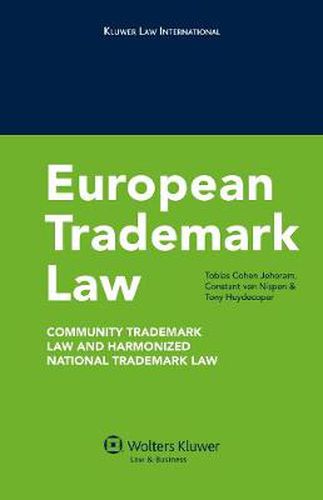
Although the European harmonisation of trademark law started more than two decades ago and is now quite robust, heretofore practitioners have had no easily accessible and comprehensive description and analysis of this regime to rely upon in their work, despite the existence of commentaries of the Directive and Regulation on trademarks. Now, European Trademark Law describes all relevant developments in both legislation and case law, in particular of the Court of Justice, offering not only a succinct introduction to the theory, structure and nature of trademark law, but also insightful suggestions for resolving and answering a host of practical problems. As the authors note, their book provides an ‘overview of trademark law rather than an overview of trademark legislation.’ The authors view the law from different perspectives; they take both the European perspective and the perspective from harmonised national trademark law, in particular as it is in the Benelux countries. Paying particular attention to the implications of the considerable stream of case law that has followed from partially new doctrines set in place by the harmonization process, the book greatly clarifies the workings and interrelations of such factors as the following: * situations that did not constitute infringement under former trademark law but do constitute infringement today and vice versa; * different types of marks and their particularities; * registration and opposition procedures; * relevant international treaties; * requirements for the mark; * grounds for refusal and invalidity; * scope of and limitations to trademark protection; * use of trademarks in comparative advertising; * referential use of trademarks; * use of trademarks on the internet; * exhaustion of rights, parallel trade; * concepts of well known trademarks and trademarks with a reputation; * procedural aspects of enforcing trademark rights; * how trademark rights are lost. The analysis also covers specific aspects of the trademark right that are related to other legal areas, such as property law, trade name law, the law regarding geographical indications of origin, copyright law, competition law, and product liability. An especially valuable part of the book’s presentation follows the ‘life’ of a trademark from filing the application up to and including its cancellation, revocation or invalidity. Intellectual property lawyers, judges, academics and in-house counsel will greatly appreciate this very useful guide to the current state of trademark law practice in Europe.
$9.00 standard shipping within Australia
FREE standard shipping within Australia for orders over $100.00
Express & International shipping calculated at checkout
Stock availability can be subject to change without notice. We recommend calling the shop or contacting our online team to check availability of low stock items. Please see our Shopping Online page for more details.
This title is printed to order. This book may have been self-published. If so, we cannot guarantee the quality of the content. In the main most books will have gone through the editing process however some may not. We therefore suggest that you be aware of this before ordering this book. If in doubt check either the author or publisher’s details as we are unable to accept any returns unless they are faulty. Please contact us if you have any questions.
Although the European harmonisation of trademark law started more than two decades ago and is now quite robust, heretofore practitioners have had no easily accessible and comprehensive description and analysis of this regime to rely upon in their work, despite the existence of commentaries of the Directive and Regulation on trademarks. Now, European Trademark Law describes all relevant developments in both legislation and case law, in particular of the Court of Justice, offering not only a succinct introduction to the theory, structure and nature of trademark law, but also insightful suggestions for resolving and answering a host of practical problems. As the authors note, their book provides an ‘overview of trademark law rather than an overview of trademark legislation.’ The authors view the law from different perspectives; they take both the European perspective and the perspective from harmonised national trademark law, in particular as it is in the Benelux countries. Paying particular attention to the implications of the considerable stream of case law that has followed from partially new doctrines set in place by the harmonization process, the book greatly clarifies the workings and interrelations of such factors as the following: * situations that did not constitute infringement under former trademark law but do constitute infringement today and vice versa; * different types of marks and their particularities; * registration and opposition procedures; * relevant international treaties; * requirements for the mark; * grounds for refusal and invalidity; * scope of and limitations to trademark protection; * use of trademarks in comparative advertising; * referential use of trademarks; * use of trademarks on the internet; * exhaustion of rights, parallel trade; * concepts of well known trademarks and trademarks with a reputation; * procedural aspects of enforcing trademark rights; * how trademark rights are lost. The analysis also covers specific aspects of the trademark right that are related to other legal areas, such as property law, trade name law, the law regarding geographical indications of origin, copyright law, competition law, and product liability. An especially valuable part of the book’s presentation follows the ‘life’ of a trademark from filing the application up to and including its cancellation, revocation or invalidity. Intellectual property lawyers, judges, academics and in-house counsel will greatly appreciate this very useful guide to the current state of trademark law practice in Europe.
Search our extensive online catalogue.
