Readings Newsletter
Become a Readings Member to make your shopping experience even easier.
Sign in or sign up for free!
You’re not far away from qualifying for FREE standard shipping within Australia
You’ve qualified for FREE standard shipping within Australia
The cart is loading…


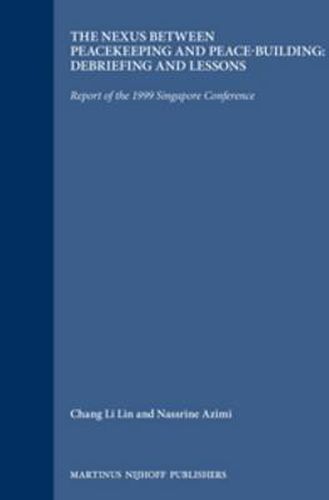
During the last few years of the 20th century, and with the collapse of the bipolar world order, new and complex conflicts have emerged which, in some cases, have ignited into larger and devastating regional wars. In the very midst of peacekeeping operations for such conflicts, experts claim, the requirements of peace-building should be considered a priority as well. It is for this reason that the United Nations, even as it deploys military and civilian forces in the four corners of the globe, seeks to set the foundations for sustainable peace. The task is daunting but the challenge impossible to ignore. Against such a background, and even as events were unfolding in East Timor and Kosovo, the fourth in a series of prestigious conferences organized on lessons learnt from peacekeeping operations was held under the auspices of the United Nations Institute for Training and Research (UNITAR), the Institute of Policy Studies (IPS) of Singapore, and the Japan Institute of International Affairs (JIIA). Throughout two intense days in Singapore, in November of 1999, an eminent group of academics, government officials, representatives of international organizations, and military scholars gathered behind closed doors to reflect upon what has been coined the nexus between peacekeeping and peace-building. This volume contains all the papers commissioned for that event. It also includes a summary of the many animated debates that took place during the conference. The broad range of opinions and perspectives it contains provides insights into a difficult and important topic, and demonstrates how dangerous it would be for the international community to ignore it. Four past cases - Angola, Haiti, Mozambique, and Cambodia - and two ongoing operations - Kosovo and East Timor - were analyzed. The findings should give policy makers, researchers and international affairs analysts a candid review and critique of past experiences that is essential for the comprehension of current peacekeeping missions and the requirement of peace-building strategies.
$9.00 standard shipping within Australia
FREE standard shipping within Australia for orders over $100.00
Express & International shipping calculated at checkout
Stock availability can be subject to change without notice. We recommend calling the shop or contacting our online team to check availability of low stock items. Please see our Shopping Online page for more details.
During the last few years of the 20th century, and with the collapse of the bipolar world order, new and complex conflicts have emerged which, in some cases, have ignited into larger and devastating regional wars. In the very midst of peacekeeping operations for such conflicts, experts claim, the requirements of peace-building should be considered a priority as well. It is for this reason that the United Nations, even as it deploys military and civilian forces in the four corners of the globe, seeks to set the foundations for sustainable peace. The task is daunting but the challenge impossible to ignore. Against such a background, and even as events were unfolding in East Timor and Kosovo, the fourth in a series of prestigious conferences organized on lessons learnt from peacekeeping operations was held under the auspices of the United Nations Institute for Training and Research (UNITAR), the Institute of Policy Studies (IPS) of Singapore, and the Japan Institute of International Affairs (JIIA). Throughout two intense days in Singapore, in November of 1999, an eminent group of academics, government officials, representatives of international organizations, and military scholars gathered behind closed doors to reflect upon what has been coined the nexus between peacekeeping and peace-building. This volume contains all the papers commissioned for that event. It also includes a summary of the many animated debates that took place during the conference. The broad range of opinions and perspectives it contains provides insights into a difficult and important topic, and demonstrates how dangerous it would be for the international community to ignore it. Four past cases - Angola, Haiti, Mozambique, and Cambodia - and two ongoing operations - Kosovo and East Timor - were analyzed. The findings should give policy makers, researchers and international affairs analysts a candid review and critique of past experiences that is essential for the comprehension of current peacekeeping missions and the requirement of peace-building strategies.
Search our extensive online catalogue.
