Readings Newsletter
Become a Readings Member to make your shopping experience even easier.
Sign in or sign up for free!
You’re not far away from qualifying for FREE standard shipping within Australia
You’ve qualified for FREE standard shipping within Australia
The cart is loading…


This title is printed to order. This book may have been self-published. If so, we cannot guarantee the quality of the content. In the main most books will have gone through the editing process however some may not. We therefore suggest that you be aware of this before ordering this book. If in doubt check either the author or publisher’s details as we are unable to accept any returns unless they are faulty. Please contact us if you have any questions.
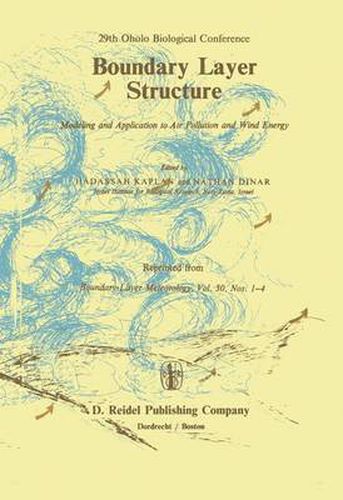
In this volume, we present the lectures given during the 1984 OHOLO Conference, held in Zichron Yaacov, Israel. The Conference was organized by the Israel Institute for Biological Research, Department of Mathematics, which is involved in Environmental Risk Evaluation, and in Projects Estimating the Potential of Wind Energy. The lectures cover a broad spectrum of mathematical models, ranging from those that deal with the solution of atmospheric conservation equations, and to those models that yield empirical estimates based on real time measure ments and thus are unique to the locale where measured. The goal of the Conference was to allow scientists from various countries to meet and discuss topics of mutual interest, including the following: 1. Structure of the boundary layer - primarily models dealing in the understanding of the various processes of atmospheric energy transfer, and their influence on the size and composition of the boundary 1 ayer. 2. Advanced mathematical techniques for describing flow and diffusion - lectures on approximations and techniques for solving the diffu sion and transport equations. 3. Flow over complex terrain - research into various aspects of the problem - mathematical models, physical models, experimental results. 4. Models of pollution transport and deposition.
$9.00 standard shipping within Australia
FREE standard shipping within Australia for orders over $100.00
Express & International shipping calculated at checkout
Stock availability can be subject to change without notice. We recommend calling the shop or contacting our online team to check availability of low stock items. Please see our Shopping Online page for more details.
This title is printed to order. This book may have been self-published. If so, we cannot guarantee the quality of the content. In the main most books will have gone through the editing process however some may not. We therefore suggest that you be aware of this before ordering this book. If in doubt check either the author or publisher’s details as we are unable to accept any returns unless they are faulty. Please contact us if you have any questions.
In this volume, we present the lectures given during the 1984 OHOLO Conference, held in Zichron Yaacov, Israel. The Conference was organized by the Israel Institute for Biological Research, Department of Mathematics, which is involved in Environmental Risk Evaluation, and in Projects Estimating the Potential of Wind Energy. The lectures cover a broad spectrum of mathematical models, ranging from those that deal with the solution of atmospheric conservation equations, and to those models that yield empirical estimates based on real time measure ments and thus are unique to the locale where measured. The goal of the Conference was to allow scientists from various countries to meet and discuss topics of mutual interest, including the following: 1. Structure of the boundary layer - primarily models dealing in the understanding of the various processes of atmospheric energy transfer, and their influence on the size and composition of the boundary 1 ayer. 2. Advanced mathematical techniques for describing flow and diffusion - lectures on approximations and techniques for solving the diffu sion and transport equations. 3. Flow over complex terrain - research into various aspects of the problem - mathematical models, physical models, experimental results. 4. Models of pollution transport and deposition.
Search our extensive online catalogue.
