Readings Newsletter
Become a Readings Member to make your shopping experience even easier.
Sign in or sign up for free!
You’re not far away from qualifying for FREE standard shipping within Australia
You’ve qualified for FREE standard shipping within Australia
The cart is loading…


This title is printed to order. This book may have been self-published. If so, we cannot guarantee the quality of the content. In the main most books will have gone through the editing process however some may not. We therefore suggest that you be aware of this before ordering this book. If in doubt check either the author or publisher’s details as we are unable to accept any returns unless they are faulty. Please contact us if you have any questions.
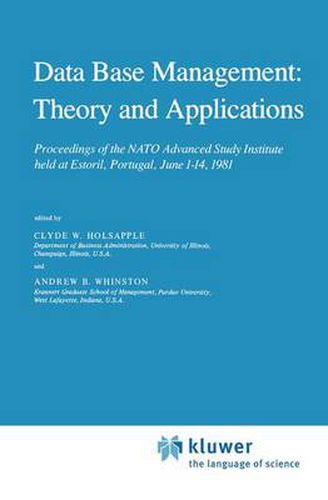
This volume is based on lectures presented at the N.A.T.O. Advanced Studies Institute on Data Base Management Theory and Applications. The meeting took place in Estoril Portugal for a two week periQd in June 1981. The lecturers represented distinguished research centers in industry, gvvernment and academia. Lectures presented basic material in data base management, as well as sharing recent developments in the field. The participants were drawn from data processing groups in government, industry and academia, located in N.A.T.O. countries. All participants had a common goal of learning about the exciting new developments in the field of data base management with the potential for application to their fields of interest. In addition to formal lectures and the informal discussions among participants, which are characteristic of N.A.T.O. AS! gatherings, participants had the opportunity for hands-on experience in building application systems with a data base management system. Participants were organized into groups that designed and implemented application systems using data base technology on micro computers. The collection of papers is organized into four major sections. The first section deals with various aspects of data modeling from the conceptual and logical perspectives. These issues are crucial in the initial design of application systems.
$9.00 standard shipping within Australia
FREE standard shipping within Australia for orders over $100.00
Express & International shipping calculated at checkout
Stock availability can be subject to change without notice. We recommend calling the shop or contacting our online team to check availability of low stock items. Please see our Shopping Online page for more details.
This title is printed to order. This book may have been self-published. If so, we cannot guarantee the quality of the content. In the main most books will have gone through the editing process however some may not. We therefore suggest that you be aware of this before ordering this book. If in doubt check either the author or publisher’s details as we are unable to accept any returns unless they are faulty. Please contact us if you have any questions.
This volume is based on lectures presented at the N.A.T.O. Advanced Studies Institute on Data Base Management Theory and Applications. The meeting took place in Estoril Portugal for a two week periQd in June 1981. The lecturers represented distinguished research centers in industry, gvvernment and academia. Lectures presented basic material in data base management, as well as sharing recent developments in the field. The participants were drawn from data processing groups in government, industry and academia, located in N.A.T.O. countries. All participants had a common goal of learning about the exciting new developments in the field of data base management with the potential for application to their fields of interest. In addition to formal lectures and the informal discussions among participants, which are characteristic of N.A.T.O. AS! gatherings, participants had the opportunity for hands-on experience in building application systems with a data base management system. Participants were organized into groups that designed and implemented application systems using data base technology on micro computers. The collection of papers is organized into four major sections. The first section deals with various aspects of data modeling from the conceptual and logical perspectives. These issues are crucial in the initial design of application systems.
Search our extensive online catalogue.
