Readings Newsletter
Become a Readings Member to make your shopping experience even easier.
Sign in or sign up for free!
You’re not far away from qualifying for FREE standard shipping within Australia
You’ve qualified for FREE standard shipping within Australia
The cart is loading…


This title is printed to order. This book may have been self-published. If so, we cannot guarantee the quality of the content. In the main most books will have gone through the editing process however some may not. We therefore suggest that you be aware of this before ordering this book. If in doubt check either the author or publisher’s details as we are unable to accept any returns unless they are faulty. Please contact us if you have any questions.
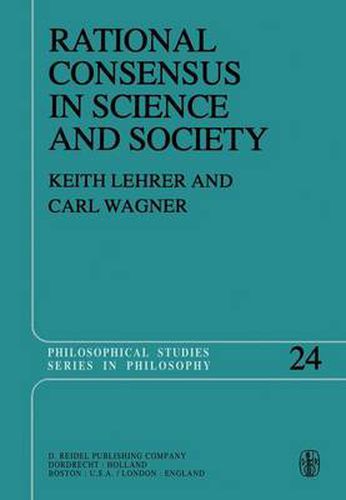
TItis book is the joint project of a philosopher, Lehrer, and a mathematician, Wagner. The book is, therefore, divided into a first part written by Lehrer, which is primarily philosophical, and a second part written by Wagner that is primarily formal. The authors were, however, influenced by each other throughout. Our book articulates a theory of rational consensus in science and society. The theory is applied to politics, ethics, science, and language. We begin our exposition with an elementary mathematical model of consensus developed by Lehrer in a series of articles [1976a, 1976b, 1977, 1978]. Chapter 3 contains material from [1978]. Lehrer formulated the elementary model when he was a Fellow of the Center for Advanced Study in the Be havioral Sciences, Stanford, in 1973 with the invaluable mathematical assist of Kit Fine, Gerald Kramer and Lionel McKenzie. In the summer of ance 1977, Lehrer and Wagner met at the Center in a Summer Seminar on Freedom and Causality supported by the Andrew W. Mellon Foundation. Wagner read the manuscript of Lehrer [1978] and subsequently solved some mathematical problems of the elementary model. After discussions of philosophical prob lems associated with that model, Wagner developed the foundations for the extended model. These results were reported in Wagner [1978, 1981a].
$9.00 standard shipping within Australia
FREE standard shipping within Australia for orders over $100.00
Express & International shipping calculated at checkout
Stock availability can be subject to change without notice. We recommend calling the shop or contacting our online team to check availability of low stock items. Please see our Shopping Online page for more details.
This title is printed to order. This book may have been self-published. If so, we cannot guarantee the quality of the content. In the main most books will have gone through the editing process however some may not. We therefore suggest that you be aware of this before ordering this book. If in doubt check either the author or publisher’s details as we are unable to accept any returns unless they are faulty. Please contact us if you have any questions.
TItis book is the joint project of a philosopher, Lehrer, and a mathematician, Wagner. The book is, therefore, divided into a first part written by Lehrer, which is primarily philosophical, and a second part written by Wagner that is primarily formal. The authors were, however, influenced by each other throughout. Our book articulates a theory of rational consensus in science and society. The theory is applied to politics, ethics, science, and language. We begin our exposition with an elementary mathematical model of consensus developed by Lehrer in a series of articles [1976a, 1976b, 1977, 1978]. Chapter 3 contains material from [1978]. Lehrer formulated the elementary model when he was a Fellow of the Center for Advanced Study in the Be havioral Sciences, Stanford, in 1973 with the invaluable mathematical assist of Kit Fine, Gerald Kramer and Lionel McKenzie. In the summer of ance 1977, Lehrer and Wagner met at the Center in a Summer Seminar on Freedom and Causality supported by the Andrew W. Mellon Foundation. Wagner read the manuscript of Lehrer [1978] and subsequently solved some mathematical problems of the elementary model. After discussions of philosophical prob lems associated with that model, Wagner developed the foundations for the extended model. These results were reported in Wagner [1978, 1981a].
Search our extensive online catalogue.
