Readings Newsletter
Become a Readings Member to make your shopping experience even easier.
Sign in or sign up for free!
You’re not far away from qualifying for FREE standard shipping within Australia
You’ve qualified for FREE standard shipping within Australia
The cart is loading…


This title is printed to order. This book may have been self-published. If so, we cannot guarantee the quality of the content. In the main most books will have gone through the editing process however some may not. We therefore suggest that you be aware of this before ordering this book. If in doubt check either the author or publisher’s details as we are unable to accept any returns unless they are faulty. Please contact us if you have any questions.
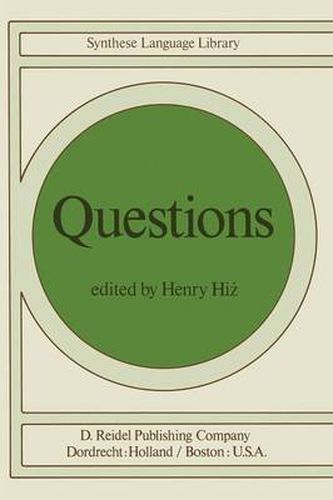
To the philosopher, the logician, and the linguist, questions have a special fascination. The two main views of language, that it describes the world, and that it expresses thought, are not directly applicable to questions. Ques tions are not assertions. A question may be apt, sharp, to the point, impor tant, or it may be inappropriate, ambiguous, awkward, irrelevant or irreverent. But it cannot be true or false. It does not have a truth value not just because an utterance like Was the letter long? does not indicate which letter is being talked about. The indicative The letter was not long has the same indeter minacy. In actual context the anaphoric definite article will be resolved both for a question and for an indicative sentence. Contextual resolutions are easily found for most cross-references. A question cannot be either true or it does not describe a state of affairs. Neither does it express false, because thought, because it is an expression of suspended thought, of lack of judge ment. To dress it in other philosophical styles, a question is not a judgment, it is not a proposition, it is not an assertion. A philosopher may try to paraphrase a question as an indicative sentence, for instance as a statement of ignorance, or as a statement of the desire to know. Hintikka, Wachowicz and Lang explore this territory. Or he may interpret it as a meta statement intimating the direction in which the flow of the discourse is going.
$9.00 standard shipping within Australia
FREE standard shipping within Australia for orders over $100.00
Express & International shipping calculated at checkout
Stock availability can be subject to change without notice. We recommend calling the shop or contacting our online team to check availability of low stock items. Please see our Shopping Online page for more details.
This title is printed to order. This book may have been self-published. If so, we cannot guarantee the quality of the content. In the main most books will have gone through the editing process however some may not. We therefore suggest that you be aware of this before ordering this book. If in doubt check either the author or publisher’s details as we are unable to accept any returns unless they are faulty. Please contact us if you have any questions.
To the philosopher, the logician, and the linguist, questions have a special fascination. The two main views of language, that it describes the world, and that it expresses thought, are not directly applicable to questions. Ques tions are not assertions. A question may be apt, sharp, to the point, impor tant, or it may be inappropriate, ambiguous, awkward, irrelevant or irreverent. But it cannot be true or false. It does not have a truth value not just because an utterance like Was the letter long? does not indicate which letter is being talked about. The indicative The letter was not long has the same indeter minacy. In actual context the anaphoric definite article will be resolved both for a question and for an indicative sentence. Contextual resolutions are easily found for most cross-references. A question cannot be either true or it does not describe a state of affairs. Neither does it express false, because thought, because it is an expression of suspended thought, of lack of judge ment. To dress it in other philosophical styles, a question is not a judgment, it is not a proposition, it is not an assertion. A philosopher may try to paraphrase a question as an indicative sentence, for instance as a statement of ignorance, or as a statement of the desire to know. Hintikka, Wachowicz and Lang explore this territory. Or he may interpret it as a meta statement intimating the direction in which the flow of the discourse is going.
Search our extensive online catalogue.
