Readings Newsletter
Become a Readings Member to make your shopping experience even easier.
Sign in or sign up for free!
You’re not far away from qualifying for FREE standard shipping within Australia
You’ve qualified for FREE standard shipping within Australia
The cart is loading…


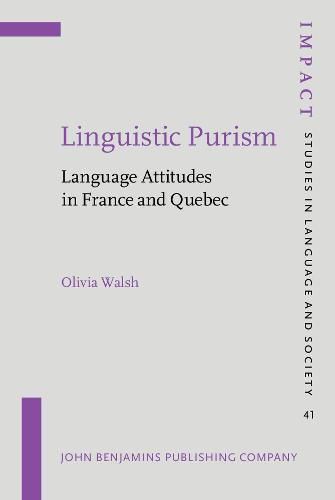
This book represents the first in-depth, comparative investigation of linguistic purism in modern French. It investigates the relative prevalence of purist ideology in France and Quebec. Both experience influence from English and have similar language legislation, but they differ in their social, political and economic history. Three different levels of society are examined (official, group and individual), allowing a comparison of the ‘voice from above’ and the ‘voice from below’. This is a key element in recent discussions of language planning but is rarely provided in studies of French. The study is also the first to apply to empirical data Thomas’s widely cited theoretical framework for describing linguistic purism (1991), and has evaluated and refined this, enhancing the theoretical underpinnings of the field. The book will be of interest not only to French scholars and sociolinguists, but also to scholars of language planning, language policy and language ideologies in all languages.
$9.00 standard shipping within Australia
FREE standard shipping within Australia for orders over $100.00
Express & International shipping calculated at checkout
Stock availability can be subject to change without notice. We recommend calling the shop or contacting our online team to check availability of low stock items. Please see our Shopping Online page for more details.
This book represents the first in-depth, comparative investigation of linguistic purism in modern French. It investigates the relative prevalence of purist ideology in France and Quebec. Both experience influence from English and have similar language legislation, but they differ in their social, political and economic history. Three different levels of society are examined (official, group and individual), allowing a comparison of the ‘voice from above’ and the ‘voice from below’. This is a key element in recent discussions of language planning but is rarely provided in studies of French. The study is also the first to apply to empirical data Thomas’s widely cited theoretical framework for describing linguistic purism (1991), and has evaluated and refined this, enhancing the theoretical underpinnings of the field. The book will be of interest not only to French scholars and sociolinguists, but also to scholars of language planning, language policy and language ideologies in all languages.
Search our extensive online catalogue.
