Readings Newsletter
Become a Readings Member to make your shopping experience even easier.
Sign in or sign up for free!
You’re not far away from qualifying for FREE standard shipping within Australia
You’ve qualified for FREE standard shipping within Australia
The cart is loading…


This title is printed to order. This book may have been self-published. If so, we cannot guarantee the quality of the content. In the main most books will have gone through the editing process however some may not. We therefore suggest that you be aware of this before ordering this book. If in doubt check either the author or publisher’s details as we are unable to accept any returns unless they are faulty. Please contact us if you have any questions.
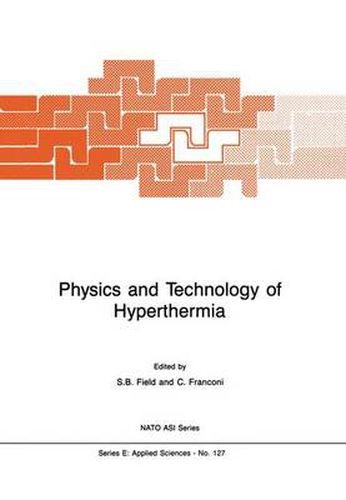
In the 1960s a firm rationale was developed for using raised temperatures to treat malignant disease and there has been a continuous expansion of the field ever since. However, a major limitation exists in our ability to heat human tumours, especially those sited deep in the body, with a reasonable degree of temperature uniformity. This problem has resulted in engineers and physicists collaborating closely with biologists and clinicians towards the common goal of developing and testing the clinical potential of this exciting treatment modality. The aim of the physicist and engineer is to develop acceptible methods of heating tumQur masses in as many sites as possible to therapeutic temperatures avoiding excessive heating of normal structures and, at the same time, obtaining the temperature distribution throughout the heated volume. The problem is magnified by both the theoretical and technical limitations of heating methods and devices. Moreover, the modelling of external deposition of energy in tissue and knowledge of tissue perfusion are ill-defined. To this must be added the conceptual difficulty of defining a thermal dose. The NATO course was designed to provide a basis for the integration of physics and technology relevant to the development of hyperthermia. There were 48 lectures covering the theoretical and practical aspects of system design and assessment, including, as far as possible, all the techniques of current interest and importance in the field.
$9.00 standard shipping within Australia
FREE standard shipping within Australia for orders over $100.00
Express & International shipping calculated at checkout
Stock availability can be subject to change without notice. We recommend calling the shop or contacting our online team to check availability of low stock items. Please see our Shopping Online page for more details.
This title is printed to order. This book may have been self-published. If so, we cannot guarantee the quality of the content. In the main most books will have gone through the editing process however some may not. We therefore suggest that you be aware of this before ordering this book. If in doubt check either the author or publisher’s details as we are unable to accept any returns unless they are faulty. Please contact us if you have any questions.
In the 1960s a firm rationale was developed for using raised temperatures to treat malignant disease and there has been a continuous expansion of the field ever since. However, a major limitation exists in our ability to heat human tumours, especially those sited deep in the body, with a reasonable degree of temperature uniformity. This problem has resulted in engineers and physicists collaborating closely with biologists and clinicians towards the common goal of developing and testing the clinical potential of this exciting treatment modality. The aim of the physicist and engineer is to develop acceptible methods of heating tumQur masses in as many sites as possible to therapeutic temperatures avoiding excessive heating of normal structures and, at the same time, obtaining the temperature distribution throughout the heated volume. The problem is magnified by both the theoretical and technical limitations of heating methods and devices. Moreover, the modelling of external deposition of energy in tissue and knowledge of tissue perfusion are ill-defined. To this must be added the conceptual difficulty of defining a thermal dose. The NATO course was designed to provide a basis for the integration of physics and technology relevant to the development of hyperthermia. There were 48 lectures covering the theoretical and practical aspects of system design and assessment, including, as far as possible, all the techniques of current interest and importance in the field.
Search our extensive online catalogue.
