Readings Newsletter
Become a Readings Member to make your shopping experience even easier.
Sign in or sign up for free!
You’re not far away from qualifying for FREE standard shipping within Australia
You’ve qualified for FREE standard shipping within Australia
The cart is loading…


This title is printed to order. This book may have been self-published. If so, we cannot guarantee the quality of the content. In the main most books will have gone through the editing process however some may not. We therefore suggest that you be aware of this before ordering this book. If in doubt check either the author or publisher’s details as we are unable to accept any returns unless they are faulty. Please contact us if you have any questions.
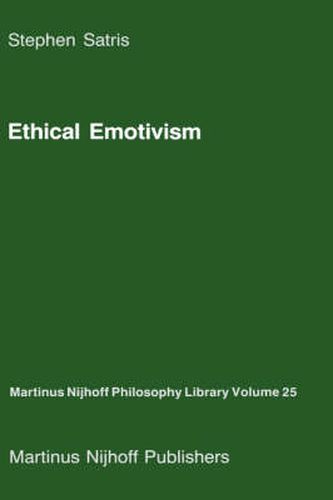
The primary contributions of this work are in three overlapping categories: (i) the history of ideas (and in particular the history of the idea of value) and moral philosophy in both continental and Anglo-American traditions, (ii) the identification and interpretation of ethical emotivism as one of the major twentieth-century ethical theories, and (iii) the evolution of a philosophically viable form of ethical emotivism as an alternative to utilitarianism and Kantianism. In addition, along the way, many particular points are touched upon, e. g. , the relation of Hume to Stevenson and emotivism, the facti value distinction, and human emotional and social nature. The work begins by challenging the received account of the development of twentieth-century moral philosophy, i. e. , the account that occurs in all the recognized historical books (such as G. c. Kerner, The Revolution in Ethical Theory, Oxford, 1966; G. 1. Warnock, Contemporary Moral Philosophy, London, 1967; W. D. Hudson, Modern Moral Philosophy, London, 1967; Mary Warnock, Ethics Since 1900, 3rd ed. , Oxford, 1978; and W. D. Hudson, A Century of Moral Philosophy, New York, 1980). This received account is not only the property of scholars of the history of recent moral philosophy but is also generally assumed by philosophers themselves, and is repeated quite uncritically in the literature at large.
$9.00 standard shipping within Australia
FREE standard shipping within Australia for orders over $100.00
Express & International shipping calculated at checkout
Stock availability can be subject to change without notice. We recommend calling the shop or contacting our online team to check availability of low stock items. Please see our Shopping Online page for more details.
This title is printed to order. This book may have been self-published. If so, we cannot guarantee the quality of the content. In the main most books will have gone through the editing process however some may not. We therefore suggest that you be aware of this before ordering this book. If in doubt check either the author or publisher’s details as we are unable to accept any returns unless they are faulty. Please contact us if you have any questions.
The primary contributions of this work are in three overlapping categories: (i) the history of ideas (and in particular the history of the idea of value) and moral philosophy in both continental and Anglo-American traditions, (ii) the identification and interpretation of ethical emotivism as one of the major twentieth-century ethical theories, and (iii) the evolution of a philosophically viable form of ethical emotivism as an alternative to utilitarianism and Kantianism. In addition, along the way, many particular points are touched upon, e. g. , the relation of Hume to Stevenson and emotivism, the facti value distinction, and human emotional and social nature. The work begins by challenging the received account of the development of twentieth-century moral philosophy, i. e. , the account that occurs in all the recognized historical books (such as G. c. Kerner, The Revolution in Ethical Theory, Oxford, 1966; G. 1. Warnock, Contemporary Moral Philosophy, London, 1967; W. D. Hudson, Modern Moral Philosophy, London, 1967; Mary Warnock, Ethics Since 1900, 3rd ed. , Oxford, 1978; and W. D. Hudson, A Century of Moral Philosophy, New York, 1980). This received account is not only the property of scholars of the history of recent moral philosophy but is also generally assumed by philosophers themselves, and is repeated quite uncritically in the literature at large.
Search our extensive online catalogue.
