Readings Newsletter
Become a Readings Member to make your shopping experience even easier.
Sign in or sign up for free!
You’re not far away from qualifying for FREE standard shipping within Australia
You’ve qualified for FREE standard shipping within Australia
The cart is loading…


This title is printed to order. This book may have been self-published. If so, we cannot guarantee the quality of the content. In the main most books will have gone through the editing process however some may not. We therefore suggest that you be aware of this before ordering this book. If in doubt check either the author or publisher’s details as we are unable to accept any returns unless they are faulty. Please contact us if you have any questions.
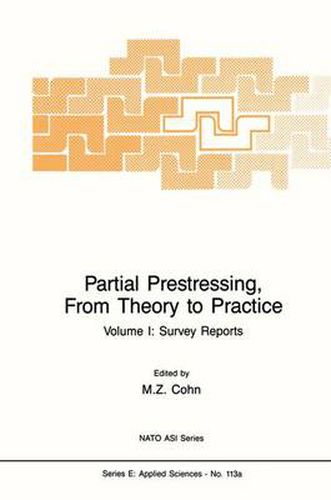
These volumes contain the edited documents presented at the NATO-Sponsored Advanced Research Workshop (ARW) on Partial Pre8tre88ing, from Theory to Practice, held at the CEBTP Research Centre of Saint-Remy-Ies-Chevreuse, France, June 18-22, 1984. The workshop was a direct extension of the International Symposium on Nonlinearity and Continuity in Pre8tre88ed Concrete, organized by the editor at the University of Waterloo, Waterloo, Canada, July 4-6, 1983. The organization of the NATO-ARW on Partial Prestressing was prompted by the need to explain and reduce the wide dirrerences of expert oph:iipn* on the subject, which make more difficult the accep tance of partial prestressing by the profession at large. Specifically, the workshop attempted to: - produce a more unified picture of partial presetressing, by con fronting and, where possible, reconciling some conflicting American and European views on this subject; - bring theoretical advances on partial prestressing within the grasp of engineering practice; - provide the required background for developing some guidelines on the use of partial prestressing, in agreement with existing structural concrete standards. The five themes selected for the workshop agenda were: (1) Problems of Partially Prestressed Concrete (PPC). (2) Partially Prestressed Concrete Members: Static Loading. (3) PPC Members: Repeated and Dynamic Loadings. (4) Continuity in Partially Prestressed Concrete. (5) Practice of Partial Prestressing.
$9.00 standard shipping within Australia
FREE standard shipping within Australia for orders over $100.00
Express & International shipping calculated at checkout
Stock availability can be subject to change without notice. We recommend calling the shop or contacting our online team to check availability of low stock items. Please see our Shopping Online page for more details.
This title is printed to order. This book may have been self-published. If so, we cannot guarantee the quality of the content. In the main most books will have gone through the editing process however some may not. We therefore suggest that you be aware of this before ordering this book. If in doubt check either the author or publisher’s details as we are unable to accept any returns unless they are faulty. Please contact us if you have any questions.
These volumes contain the edited documents presented at the NATO-Sponsored Advanced Research Workshop (ARW) on Partial Pre8tre88ing, from Theory to Practice, held at the CEBTP Research Centre of Saint-Remy-Ies-Chevreuse, France, June 18-22, 1984. The workshop was a direct extension of the International Symposium on Nonlinearity and Continuity in Pre8tre88ed Concrete, organized by the editor at the University of Waterloo, Waterloo, Canada, July 4-6, 1983. The organization of the NATO-ARW on Partial Prestressing was prompted by the need to explain and reduce the wide dirrerences of expert oph:iipn* on the subject, which make more difficult the accep tance of partial prestressing by the profession at large. Specifically, the workshop attempted to: - produce a more unified picture of partial presetressing, by con fronting and, where possible, reconciling some conflicting American and European views on this subject; - bring theoretical advances on partial prestressing within the grasp of engineering practice; - provide the required background for developing some guidelines on the use of partial prestressing, in agreement with existing structural concrete standards. The five themes selected for the workshop agenda were: (1) Problems of Partially Prestressed Concrete (PPC). (2) Partially Prestressed Concrete Members: Static Loading. (3) PPC Members: Repeated and Dynamic Loadings. (4) Continuity in Partially Prestressed Concrete. (5) Practice of Partial Prestressing.
Search our extensive online catalogue.
