Readings Newsletter
Become a Readings Member to make your shopping experience even easier.
Sign in or sign up for free!
You’re not far away from qualifying for FREE standard shipping within Australia
You’ve qualified for FREE standard shipping within Australia
The cart is loading…


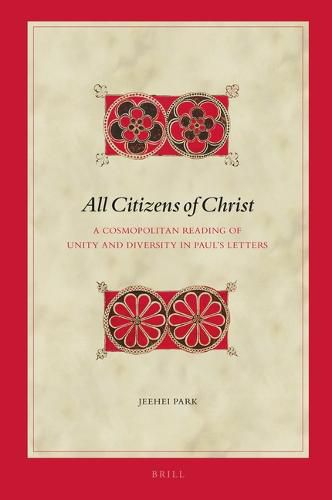
In this work, Jeehei Park proposes Greek and Roman cosmopolitanism as a constructive category through which to navigate a reading of human diversity and communal unity in Paul’s letters. Park takes a thorough look at the cosmopolitan ideas of Diogenes of Sinope, Philo, Plutarch, Epictetus, and Marcus Aurelius to establish Paul as an interlocutor who critically participated in the discourse of cosmopolitanism. Park characterizes Paul’s understanding of unity with the distinctive phrase heterogeneous unity, in which human differences are respected and embraced rather than being universalized or homogenized. This book offers a novel analysis of Paul’s rhetoric about citizenship in Philippians and its adoption of Greek and Roman cosmopolitanism as an interpretive contour.
$9.00 standard shipping within Australia
FREE standard shipping within Australia for orders over $100.00
Express & International shipping calculated at checkout
Stock availability can be subject to change without notice. We recommend calling the shop or contacting our online team to check availability of low stock items. Please see our Shopping Online page for more details.
In this work, Jeehei Park proposes Greek and Roman cosmopolitanism as a constructive category through which to navigate a reading of human diversity and communal unity in Paul’s letters. Park takes a thorough look at the cosmopolitan ideas of Diogenes of Sinope, Philo, Plutarch, Epictetus, and Marcus Aurelius to establish Paul as an interlocutor who critically participated in the discourse of cosmopolitanism. Park characterizes Paul’s understanding of unity with the distinctive phrase heterogeneous unity, in which human differences are respected and embraced rather than being universalized or homogenized. This book offers a novel analysis of Paul’s rhetoric about citizenship in Philippians and its adoption of Greek and Roman cosmopolitanism as an interpretive contour.
Search our extensive online catalogue.
