Readings Newsletter
Become a Readings Member to make your shopping experience even easier.
Sign in or sign up for free!
You’re not far away from qualifying for FREE standard shipping within Australia
You’ve qualified for FREE standard shipping within Australia
The cart is loading…


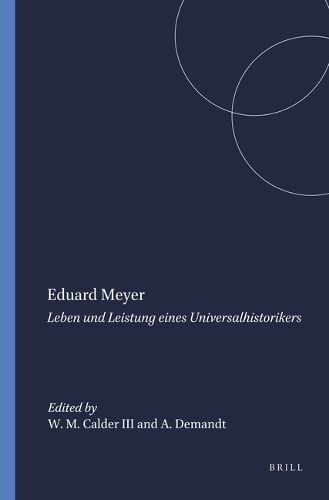
Eduard Meyer (1855-1930) was among the most important historians of his age. After Mommsen he is the best known German ancient historian. From 1902 he taught ancient history in Berlin and from 1919/20 he was vice-chancellor. His most important work Geschichte des Altertums includes the ancient oriental cultures, contains a sociological- anthropological methodology and considers all humane studies, especially religious history. This collection treats aspects of Meyer’s biography - including his journey to America, his relations with his contemporaries (M. Weber, O. Spengler, U.von Wilamowitz), his university politics, his role in the First World War, his positions on Christianity and Judaism, history of philosophy, and particular research results and their effect.
$9.00 standard shipping within Australia
FREE standard shipping within Australia for orders over $100.00
Express & International shipping calculated at checkout
Stock availability can be subject to change without notice. We recommend calling the shop or contacting our online team to check availability of low stock items. Please see our Shopping Online page for more details.
Eduard Meyer (1855-1930) was among the most important historians of his age. After Mommsen he is the best known German ancient historian. From 1902 he taught ancient history in Berlin and from 1919/20 he was vice-chancellor. His most important work Geschichte des Altertums includes the ancient oriental cultures, contains a sociological- anthropological methodology and considers all humane studies, especially religious history. This collection treats aspects of Meyer’s biography - including his journey to America, his relations with his contemporaries (M. Weber, O. Spengler, U.von Wilamowitz), his university politics, his role in the First World War, his positions on Christianity and Judaism, history of philosophy, and particular research results and their effect.
Search our extensive online catalogue.
