Readings Newsletter
Become a Readings Member to make your shopping experience even easier.
Sign in or sign up for free!
You’re not far away from qualifying for FREE standard shipping within Australia
You’ve qualified for FREE standard shipping within Australia
The cart is loading…


This title is printed to order. This book may have been self-published. If so, we cannot guarantee the quality of the content. In the main most books will have gone through the editing process however some may not. We therefore suggest that you be aware of this before ordering this book. If in doubt check either the author or publisher’s details as we are unable to accept any returns unless they are faulty. Please contact us if you have any questions.
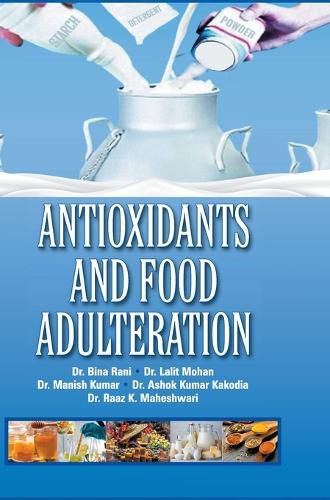
Food adulteration is a problem that affects the entire world, and underdeveloped nations are more vulnerable to it owing to a lack of rules and monitoring which takes place frequently in its most blatant form when illegal materials are replaced or added in full. Food is frequently contaminated to satisfy the demands of this expanding population and to feed the vast population because the world's population is increasing at an alarming rate. Food autoxidation and rancidity development are caused by a free radical chain mechanism. Antioxidants are chemicals that, when present in meals in small amounts relative to an oxidizable substrate, significantly slow down or stop the oxidation of the substrates present in the food. Free radicals can be quenched, decomposed, or scavenged by them. The presence of antioxidants in food is a crucial resource for the food business in order to maximize the effectiveness of these key additions. Therefore, concern knowledge is required on these concepts for understanding the adulteration, their types and detection methods as well as the role of antioxidants in food, medicine and healthcare, or to prevent or regulate oxidation in food products. The primary goal of publishing this book is to make the useful information available to anyone who is interested in it. The book includes eleven chapters which aim to present the knowledge of food adulteration and Antioxidants and various other associated concepts for Wellbeing.
$9.00 standard shipping within Australia
FREE standard shipping within Australia for orders over $100.00
Express & International shipping calculated at checkout
Stock availability can be subject to change without notice. We recommend calling the shop or contacting our online team to check availability of low stock items. Please see our Shopping Online page for more details.
This title is printed to order. This book may have been self-published. If so, we cannot guarantee the quality of the content. In the main most books will have gone through the editing process however some may not. We therefore suggest that you be aware of this before ordering this book. If in doubt check either the author or publisher’s details as we are unable to accept any returns unless they are faulty. Please contact us if you have any questions.
Food adulteration is a problem that affects the entire world, and underdeveloped nations are more vulnerable to it owing to a lack of rules and monitoring which takes place frequently in its most blatant form when illegal materials are replaced or added in full. Food is frequently contaminated to satisfy the demands of this expanding population and to feed the vast population because the world's population is increasing at an alarming rate. Food autoxidation and rancidity development are caused by a free radical chain mechanism. Antioxidants are chemicals that, when present in meals in small amounts relative to an oxidizable substrate, significantly slow down or stop the oxidation of the substrates present in the food. Free radicals can be quenched, decomposed, or scavenged by them. The presence of antioxidants in food is a crucial resource for the food business in order to maximize the effectiveness of these key additions. Therefore, concern knowledge is required on these concepts for understanding the adulteration, their types and detection methods as well as the role of antioxidants in food, medicine and healthcare, or to prevent or regulate oxidation in food products. The primary goal of publishing this book is to make the useful information available to anyone who is interested in it. The book includes eleven chapters which aim to present the knowledge of food adulteration and Antioxidants and various other associated concepts for Wellbeing.
Search our extensive online catalogue.
