Readings Newsletter
Become a Readings Member to make your shopping experience even easier.
Sign in or sign up for free!
You’re not far away from qualifying for FREE standard shipping within Australia
You’ve qualified for FREE standard shipping within Australia
The cart is loading…


This title is printed to order. This book may have been self-published. If so, we cannot guarantee the quality of the content. In the main most books will have gone through the editing process however some may not. We therefore suggest that you be aware of this before ordering this book. If in doubt check either the author or publisher’s details as we are unable to accept any returns unless they are faulty. Please contact us if you have any questions.
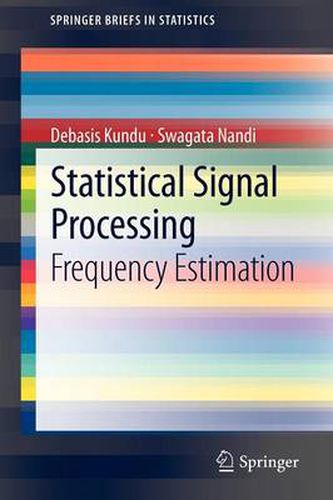
Signal processing may broadly be considered to involve the recovery of information from physical observations. The received signal is usually disturbed by thermal, electrical, atmospheric or intentional interferences. Due to the random nature of the signal, statistical techniques play an important role in analyzing the signal. Statistics is also used in the formulation of the appropriate models to describe the behavior of the system, the development of appropriate techniques for estimation of model parameters and the assessment of the model performances. Statistical signal processing basically refers to the analysis of random signals using appropriate statistical techniques. The main aim of this book is to introduce different signal processing models which have been used in analyzing periodic data, and different statistical and computational issues involved in solving them. We discuss in detail the sinusoidal frequency model which has been used extensively in analyzing periodic data occuring in various fields. We have tried to introduce different associated models and higher dimensional statistical signal processing models which have been further discussed in the literature. Different real data sets have been analyzed to illustrate how different models can be used in practice. Several open problems have been indicated for future research.
$9.00 standard shipping within Australia
FREE standard shipping within Australia for orders over $100.00
Express & International shipping calculated at checkout
Stock availability can be subject to change without notice. We recommend calling the shop or contacting our online team to check availability of low stock items. Please see our Shopping Online page for more details.
This title is printed to order. This book may have been self-published. If so, we cannot guarantee the quality of the content. In the main most books will have gone through the editing process however some may not. We therefore suggest that you be aware of this before ordering this book. If in doubt check either the author or publisher’s details as we are unable to accept any returns unless they are faulty. Please contact us if you have any questions.
Signal processing may broadly be considered to involve the recovery of information from physical observations. The received signal is usually disturbed by thermal, electrical, atmospheric or intentional interferences. Due to the random nature of the signal, statistical techniques play an important role in analyzing the signal. Statistics is also used in the formulation of the appropriate models to describe the behavior of the system, the development of appropriate techniques for estimation of model parameters and the assessment of the model performances. Statistical signal processing basically refers to the analysis of random signals using appropriate statistical techniques. The main aim of this book is to introduce different signal processing models which have been used in analyzing periodic data, and different statistical and computational issues involved in solving them. We discuss in detail the sinusoidal frequency model which has been used extensively in analyzing periodic data occuring in various fields. We have tried to introduce different associated models and higher dimensional statistical signal processing models which have been further discussed in the literature. Different real data sets have been analyzed to illustrate how different models can be used in practice. Several open problems have been indicated for future research.
Search our extensive online catalogue.
