Readings Newsletter
Become a Readings Member to make your shopping experience even easier.
Sign in or sign up for free!
You’re not far away from qualifying for FREE standard shipping within Australia
You’ve qualified for FREE standard shipping within Australia
The cart is loading…


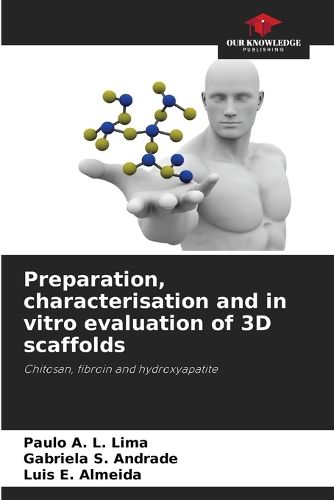
3D scaffolds made of chitosan (CHI), fibroin (SF) and hydroxyapatite (HA) are biocompatible and attractive for applications in bone tissue engineering. Therefore, the objective was to prepare, characterise and evaluate the in vitro behaviour of 3D scaffolds made of CHI, CHI/SF and CHI/SF/HA. The biomaterials were produced from a solution of CHI, CHI/SF and CHI/SF/HA in acetic acid and, after the production processes, were subjected to in vitro tests with SaOS-2 cells for 7, 14 and 21 days. The scaffolds were characterised by X-ray diffraction, Fourier transform infrared spectroscopy with attenuated total reflectance, thermogravimetric analysis, differential scanning calorimetry, scanning electron microscopy, energy dispersive spectroscopy, and tested for porosity, pore size and contact angle. Viability and cellular activity were evaluated by MTT reduction and detection of alkaline phosphatase activity. The 3D scaffolds were considered non-toxic and capable of promoting cell adhesion, proliferation, and differentiation, and can be used in bone defect repair therapy.
$9.00 standard shipping within Australia
FREE standard shipping within Australia for orders over $100.00
Express & International shipping calculated at checkout
Stock availability can be subject to change without notice. We recommend calling the shop or contacting our online team to check availability of low stock items. Please see our Shopping Online page for more details.
3D scaffolds made of chitosan (CHI), fibroin (SF) and hydroxyapatite (HA) are biocompatible and attractive for applications in bone tissue engineering. Therefore, the objective was to prepare, characterise and evaluate the in vitro behaviour of 3D scaffolds made of CHI, CHI/SF and CHI/SF/HA. The biomaterials were produced from a solution of CHI, CHI/SF and CHI/SF/HA in acetic acid and, after the production processes, were subjected to in vitro tests with SaOS-2 cells for 7, 14 and 21 days. The scaffolds were characterised by X-ray diffraction, Fourier transform infrared spectroscopy with attenuated total reflectance, thermogravimetric analysis, differential scanning calorimetry, scanning electron microscopy, energy dispersive spectroscopy, and tested for porosity, pore size and contact angle. Viability and cellular activity were evaluated by MTT reduction and detection of alkaline phosphatase activity. The 3D scaffolds were considered non-toxic and capable of promoting cell adhesion, proliferation, and differentiation, and can be used in bone defect repair therapy.
Search our extensive online catalogue.
