Readings Newsletter
Become a Readings Member to make your shopping experience even easier.
Sign in or sign up for free!
You’re not far away from qualifying for FREE standard shipping within Australia
You’ve qualified for FREE standard shipping within Australia
The cart is loading…


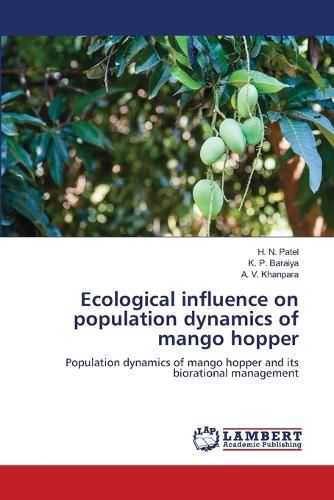
The investigation on "Ecological influence on population dynamics of mango hopper" was carried out at JAU research stations and farmer orchards in Junagadh, Mendarda and Dhari during 2021-23. Hopper populations peaked on inflorescences in the 9th SMW and on trunks around 44th-48th SMW, with canopy peaks varying across varieties. Alphonso recorded the highest infestation, followed by Kesar and Rajapuri, with Junagadh showing maximum hopper populations, Mendarda moderate and Dhari least. Correlation studies revealed hopper incidence was positively linked with sunshine hours, humidity fluctuation, GDD and negatively with temperature and evaporation. GDD analysis showed higher cumulative heat units accelerated hopper build-up, with distinct varietal responses. Screening indicated Alphonso most susceptible, Rajapuri least. For management, azadirachtin 1EC @0.005% proved superior, recording lowest hopper population (3.04/inflorescence) and highest yield (90.87 q/ha). Yield increase over control was highest with azadirachtin (63.49%), while maximum ICBR was with azadirachtin @0.003% (1:7.89), followed by Lecanicilliumlecanii (1:7.58), highlighting potential of biorationals for management.
$9.00 standard shipping within Australia
FREE standard shipping within Australia for orders over $100.00
Express & International shipping calculated at checkout
Stock availability can be subject to change without notice. We recommend calling the shop or contacting our online team to check availability of low stock items. Please see our Shopping Online page for more details.
The investigation on "Ecological influence on population dynamics of mango hopper" was carried out at JAU research stations and farmer orchards in Junagadh, Mendarda and Dhari during 2021-23. Hopper populations peaked on inflorescences in the 9th SMW and on trunks around 44th-48th SMW, with canopy peaks varying across varieties. Alphonso recorded the highest infestation, followed by Kesar and Rajapuri, with Junagadh showing maximum hopper populations, Mendarda moderate and Dhari least. Correlation studies revealed hopper incidence was positively linked with sunshine hours, humidity fluctuation, GDD and negatively with temperature and evaporation. GDD analysis showed higher cumulative heat units accelerated hopper build-up, with distinct varietal responses. Screening indicated Alphonso most susceptible, Rajapuri least. For management, azadirachtin 1EC @0.005% proved superior, recording lowest hopper population (3.04/inflorescence) and highest yield (90.87 q/ha). Yield increase over control was highest with azadirachtin (63.49%), while maximum ICBR was with azadirachtin @0.003% (1:7.89), followed by Lecanicilliumlecanii (1:7.58), highlighting potential of biorationals for management.
Search our extensive online catalogue.
