Readings Newsletter
Become a Readings Member to make your shopping experience even easier.
Sign in or sign up for free!
You’re not far away from qualifying for FREE standard shipping within Australia
You’ve qualified for FREE standard shipping within Australia
The cart is loading…


This title is printed to order. This book may have been self-published. If so, we cannot guarantee the quality of the content. In the main most books will have gone through the editing process however some may not. We therefore suggest that you be aware of this before ordering this book. If in doubt check either the author or publisher’s details as we are unable to accept any returns unless they are faulty. Please contact us if you have any questions.
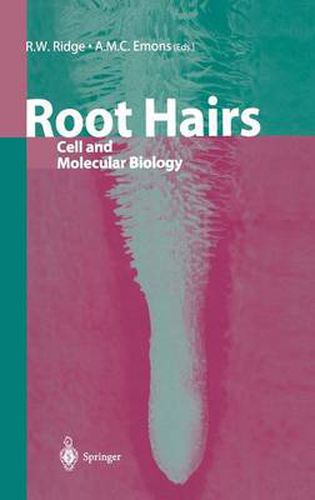
Root hairs are tip-growing cells that originate from epidennal cells called trichoblasts. Their role may be simply thought of as extending the surface area of the root to facilitate absorption of nutrients and water. However, as you will see in this book, the root hair is far more than that. To an increasingly larger number of plant biologists, the root hair is a model cell. It grows in much the same way as a pollen tube, by sending vast numbers of vesicles containing cell wall precursors to a rounded apical dome, the tip. Once the trichoblast becomes committed to root hair fonnation, it no longer divides. The root hair cell has a migrating nucleus and a complex cytoskeleton. It has a varied cell wall. It is easy to observe through differential interference contrast microscopy because there are no other cells around it to disturb the image. Cytoplasmic streaming is exceptionally clear, and amyloplasts and even mitochondria and endoplasmic reticulum can be seen without reporter labelling in some species. Root hair mutants are easy to distinguish and catalogue. Plant honnones are involved in their growth and development. It is thus an almost ideal plant cell for experimental manipulation and observation. The root hair is also involved in interactions with soil microbes, as you will learn from later chapters of the book.
$9.00 standard shipping within Australia
FREE standard shipping within Australia for orders over $100.00
Express & International shipping calculated at checkout
Stock availability can be subject to change without notice. We recommend calling the shop or contacting our online team to check availability of low stock items. Please see our Shopping Online page for more details.
This title is printed to order. This book may have been self-published. If so, we cannot guarantee the quality of the content. In the main most books will have gone through the editing process however some may not. We therefore suggest that you be aware of this before ordering this book. If in doubt check either the author or publisher’s details as we are unable to accept any returns unless they are faulty. Please contact us if you have any questions.
Root hairs are tip-growing cells that originate from epidennal cells called trichoblasts. Their role may be simply thought of as extending the surface area of the root to facilitate absorption of nutrients and water. However, as you will see in this book, the root hair is far more than that. To an increasingly larger number of plant biologists, the root hair is a model cell. It grows in much the same way as a pollen tube, by sending vast numbers of vesicles containing cell wall precursors to a rounded apical dome, the tip. Once the trichoblast becomes committed to root hair fonnation, it no longer divides. The root hair cell has a migrating nucleus and a complex cytoskeleton. It has a varied cell wall. It is easy to observe through differential interference contrast microscopy because there are no other cells around it to disturb the image. Cytoplasmic streaming is exceptionally clear, and amyloplasts and even mitochondria and endoplasmic reticulum can be seen without reporter labelling in some species. Root hair mutants are easy to distinguish and catalogue. Plant honnones are involved in their growth and development. It is thus an almost ideal plant cell for experimental manipulation and observation. The root hair is also involved in interactions with soil microbes, as you will learn from later chapters of the book.
Search our extensive online catalogue.
