Readings Newsletter
Become a Readings Member to make your shopping experience even easier.
Sign in or sign up for free!
You’re not far away from qualifying for FREE standard shipping within Australia
You’ve qualified for FREE standard shipping within Australia
The cart is loading…


This title is printed to order. This book may have been self-published. If so, we cannot guarantee the quality of the content. In the main most books will have gone through the editing process however some may not. We therefore suggest that you be aware of this before ordering this book. If in doubt check either the author or publisher’s details as we are unable to accept any returns unless they are faulty. Please contact us if you have any questions.
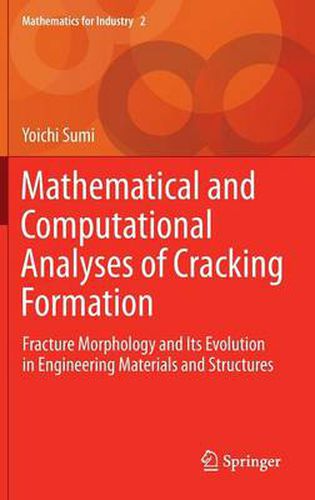
This book is about the pattern formation and the evolution of crack propagation in engineering materials and structures, bridging mathematical analyses of cracks based on singular integral equations, to computational simulation of engineering design. The first two parts of this book focus on elasticity and fracture and provide the basis for discussions on fracture morphology and its numerical simulation, which may lead to a simulation-based fracture control in engineering structures. Several design concepts are discussed for the prevention of fatigue and fracture in engineering structures, including safe-life design, fail-safe design, damage tolerant design.
After starting with basic elasticity and fracture theories in parts one and two, this book focuses on the fracture morphology that develops due to the propagation of brittle cracks or fatigue cracks.
In part three, the mathematical analysis of a curved crack is precisely described, based on the perturbation method. The stability theory of interactive cracks propagating in brittle solids may help readers to understand the formation of a fractal-like cracking patterns in brittle solids, while the stability theory of crack paths helps to identify the straight versus sharply curved or sometimes wavy crack paths observed in brittle solids.
In part four, the numerical simulation method of a system of multiple cracks is introduced by means of the finite element method, which may be used for the better implementation of fracture control in engineering structures.
This book is part of a series on Mathematics for Industry and will appeal to structural engineers seeking to understand the basic backgrounds of analyses, but also to mathematicians with an interest in how such mathematical solutions are evaluated in industrial applications.
$9.00 standard shipping within Australia
FREE standard shipping within Australia for orders over $100.00
Express & International shipping calculated at checkout
Stock availability can be subject to change without notice. We recommend calling the shop or contacting our online team to check availability of low stock items. Please see our Shopping Online page for more details.
This title is printed to order. This book may have been self-published. If so, we cannot guarantee the quality of the content. In the main most books will have gone through the editing process however some may not. We therefore suggest that you be aware of this before ordering this book. If in doubt check either the author or publisher’s details as we are unable to accept any returns unless they are faulty. Please contact us if you have any questions.
This book is about the pattern formation and the evolution of crack propagation in engineering materials and structures, bridging mathematical analyses of cracks based on singular integral equations, to computational simulation of engineering design. The first two parts of this book focus on elasticity and fracture and provide the basis for discussions on fracture morphology and its numerical simulation, which may lead to a simulation-based fracture control in engineering structures. Several design concepts are discussed for the prevention of fatigue and fracture in engineering structures, including safe-life design, fail-safe design, damage tolerant design.
After starting with basic elasticity and fracture theories in parts one and two, this book focuses on the fracture morphology that develops due to the propagation of brittle cracks or fatigue cracks.
In part three, the mathematical analysis of a curved crack is precisely described, based on the perturbation method. The stability theory of interactive cracks propagating in brittle solids may help readers to understand the formation of a fractal-like cracking patterns in brittle solids, while the stability theory of crack paths helps to identify the straight versus sharply curved or sometimes wavy crack paths observed in brittle solids.
In part four, the numerical simulation method of a system of multiple cracks is introduced by means of the finite element method, which may be used for the better implementation of fracture control in engineering structures.
This book is part of a series on Mathematics for Industry and will appeal to structural engineers seeking to understand the basic backgrounds of analyses, but also to mathematicians with an interest in how such mathematical solutions are evaluated in industrial applications.
Search our extensive online catalogue.
