Readings Newsletter
Become a Readings Member to make your shopping experience even easier.
Sign in or sign up for free!
You’re not far away from qualifying for FREE standard shipping within Australia
You’ve qualified for FREE standard shipping within Australia
The cart is loading…


This title is printed to order. This book may have been self-published. If so, we cannot guarantee the quality of the content. In the main most books will have gone through the editing process however some may not. We therefore suggest that you be aware of this before ordering this book. If in doubt check either the author or publisher’s details as we are unable to accept any returns unless they are faulty. Please contact us if you have any questions.
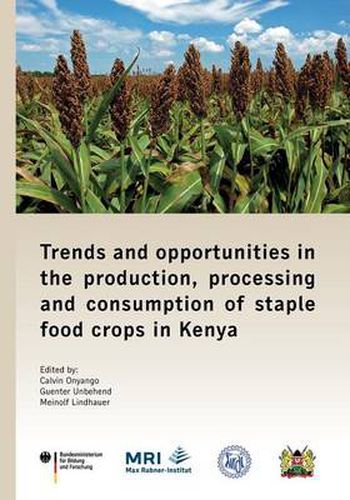
The objective of the national conference on Trends and opportunities in the production, processing and consumption of staple food crops in Kenya was to communicate the findings of a two-year research project to academic peers, industrialists, policy-makers and regulatory officials. The aim of the project was to investigate the potential of utilizing sorghum and cassava to make gluten-free bread (i.e. bread from non-wheat flours) and composite bread (i.e. bread from wheat and non-wheat flours). Bread was selected as the vehicle to promote these crops because it is a ubiquitous food product that is eaten across all social classes, is culturally accepted across the country and is convenient to handle, store and consume. Some results of this project are presented in Chapter 1 and 3. The project was undertaken by the Food Technology Division at Kenya Industrial Research and Development Institute (KIRDI, Nairobi, Kenya), and the Department of Safety and Quality of Cereals at Max Rubner-Institut (MRI, Detmold, Germany). The project (Project No.: KEN 10/001) and conference were supported by Bundesministerium fur Bildung und Forschung / Federal German Ministry of Education and Research (BMBF, Germany) and Ministry of Industrilaization and Enterprise Development, Kenya. Additional financial support was provided by Deutscher Akademischer Austausch Dienst (DAAD) to enable DAAD-Alumni attend the conference. We were aware that several other research activities, technology transfer initiatives and policy recalibration efforts are ongoing in the country to develop a vibrant staple food crops sector. It is for this reason that we invited contributions from other stakeholders. The contributions addressed policy and regulation, research, extension, production, processing and consumption of staple food crops in Kenya. Full-length articles of some of the presentations made at the conference are presented in this book.
$9.00 standard shipping within Australia
FREE standard shipping within Australia for orders over $100.00
Express & International shipping calculated at checkout
Stock availability can be subject to change without notice. We recommend calling the shop or contacting our online team to check availability of low stock items. Please see our Shopping Online page for more details.
This title is printed to order. This book may have been self-published. If so, we cannot guarantee the quality of the content. In the main most books will have gone through the editing process however some may not. We therefore suggest that you be aware of this before ordering this book. If in doubt check either the author or publisher’s details as we are unable to accept any returns unless they are faulty. Please contact us if you have any questions.
The objective of the national conference on Trends and opportunities in the production, processing and consumption of staple food crops in Kenya was to communicate the findings of a two-year research project to academic peers, industrialists, policy-makers and regulatory officials. The aim of the project was to investigate the potential of utilizing sorghum and cassava to make gluten-free bread (i.e. bread from non-wheat flours) and composite bread (i.e. bread from wheat and non-wheat flours). Bread was selected as the vehicle to promote these crops because it is a ubiquitous food product that is eaten across all social classes, is culturally accepted across the country and is convenient to handle, store and consume. Some results of this project are presented in Chapter 1 and 3. The project was undertaken by the Food Technology Division at Kenya Industrial Research and Development Institute (KIRDI, Nairobi, Kenya), and the Department of Safety and Quality of Cereals at Max Rubner-Institut (MRI, Detmold, Germany). The project (Project No.: KEN 10/001) and conference were supported by Bundesministerium fur Bildung und Forschung / Federal German Ministry of Education and Research (BMBF, Germany) and Ministry of Industrilaization and Enterprise Development, Kenya. Additional financial support was provided by Deutscher Akademischer Austausch Dienst (DAAD) to enable DAAD-Alumni attend the conference. We were aware that several other research activities, technology transfer initiatives and policy recalibration efforts are ongoing in the country to develop a vibrant staple food crops sector. It is for this reason that we invited contributions from other stakeholders. The contributions addressed policy and regulation, research, extension, production, processing and consumption of staple food crops in Kenya. Full-length articles of some of the presentations made at the conference are presented in this book.
Search our extensive online catalogue.
