Readings Newsletter
Become a Readings Member to make your shopping experience even easier.
Sign in or sign up for free!
You’re not far away from qualifying for FREE standard shipping within Australia
You’ve qualified for FREE standard shipping within Australia
The cart is loading…


This title is printed to order. This book may have been self-published. If so, we cannot guarantee the quality of the content. In the main most books will have gone through the editing process however some may not. We therefore suggest that you be aware of this before ordering this book. If in doubt check either the author or publisher’s details as we are unable to accept any returns unless they are faulty. Please contact us if you have any questions.
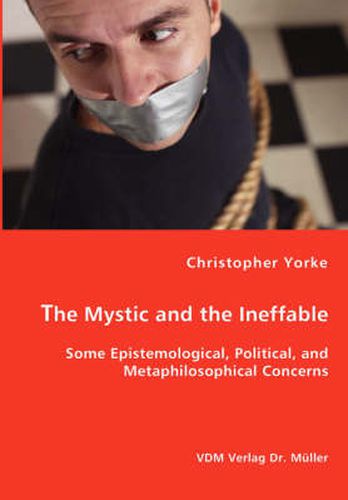
Mysticism and the sciences have traditionally been theoretical enemies, and the closer that philosophy allies itself with the sciences, the greater the philosophical tendency has been to attack mysticism as a possible avenue towards the acquisition of knowledge and/or understanding. Science and modern philosophy generally aim for epistemic disclosure of their contents, and, conversely, mysticism either aims at the restriction of esoteric knowledge, or claims such knowledge to be non-transferable. Thus the mystic is typically seen by analytic philosophers as a variety of ‘private language’ speaker, although the plausibility of such a position is seemingly foreclosed by Wittgenstein’s work in the Philosophical Investigations. Yorke re-examines Wittgenstein’s conclusion on the matter of private language, and argues that so-called ‘ineffable’ mystical experiences, far from being a ‘beetle in a box’, can play a viable role in our public language-games, via renewed efforts at articulation.
$9.00 standard shipping within Australia
FREE standard shipping within Australia for orders over $100.00
Express & International shipping calculated at checkout
Stock availability can be subject to change without notice. We recommend calling the shop or contacting our online team to check availability of low stock items. Please see our Shopping Online page for more details.
This title is printed to order. This book may have been self-published. If so, we cannot guarantee the quality of the content. In the main most books will have gone through the editing process however some may not. We therefore suggest that you be aware of this before ordering this book. If in doubt check either the author or publisher’s details as we are unable to accept any returns unless they are faulty. Please contact us if you have any questions.
Mysticism and the sciences have traditionally been theoretical enemies, and the closer that philosophy allies itself with the sciences, the greater the philosophical tendency has been to attack mysticism as a possible avenue towards the acquisition of knowledge and/or understanding. Science and modern philosophy generally aim for epistemic disclosure of their contents, and, conversely, mysticism either aims at the restriction of esoteric knowledge, or claims such knowledge to be non-transferable. Thus the mystic is typically seen by analytic philosophers as a variety of ‘private language’ speaker, although the plausibility of such a position is seemingly foreclosed by Wittgenstein’s work in the Philosophical Investigations. Yorke re-examines Wittgenstein’s conclusion on the matter of private language, and argues that so-called ‘ineffable’ mystical experiences, far from being a ‘beetle in a box’, can play a viable role in our public language-games, via renewed efforts at articulation.
Search our extensive online catalogue.
