Readings Newsletter
Become a Readings Member to make your shopping experience even easier.
Sign in or sign up for free!
You’re not far away from qualifying for FREE standard shipping within Australia
You’ve qualified for FREE standard shipping within Australia
The cart is loading…


This title is printed to order. This book may have been self-published. If so, we cannot guarantee the quality of the content. In the main most books will have gone through the editing process however some may not. We therefore suggest that you be aware of this before ordering this book. If in doubt check either the author or publisher’s details as we are unable to accept any returns unless they are faulty. Please contact us if you have any questions.
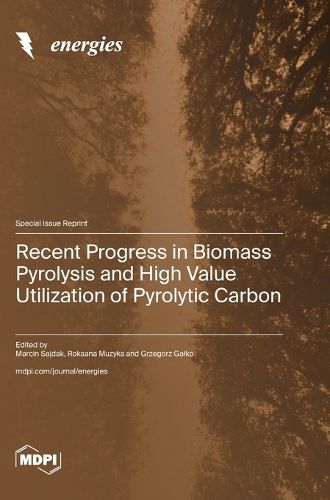
Biomass is one of the most readily available sources of sustainable energy and its processed products can be used not only as a source of energy but also as a source of technologically important carbon materials. This Special Issue presents the latest research on biomass pyrolysis and the utilisation of biochar. In this SI, scientists have undertaken, among other things, an analysis of the influence of biocomponent additives on the coking properties of coal mixtures, developing mathematical models to predict changes in these parameters. Recent research on biomass pyrolysis is providing new technological solutions, such as the development of a new two-chamber reactor to produce biochar from rice husks, adapted to the needs of small farms, which highlights the importance of local solutions. Biochar is a valuable raw material whose importance is growing, for example, in metallurgy and steelmaking, where mixtures of biochar and coke have been shown to improve the properties of slagging and process stability. The use of mathematical methods in optimising the gasification of sewage sludge has enabled high energy efficiency and CO? emission reductions to be achieved, demonstrating that thermal biomass conversion methods still have potential for decarbonisation. The research described in this Special Issue also covers the application of food waste, the co-pyrolysis of lignin and plastic waste, and torrefied wood to obtain high-energy products, and a significant reduction in CO? emissions in the metallurgical industry. This research highlights the potential of biomass pyrolysis as a tool for energy transition and the circular economy.
$9.00 standard shipping within Australia
FREE standard shipping within Australia for orders over $100.00
Express & International shipping calculated at checkout
Stock availability can be subject to change without notice. We recommend calling the shop or contacting our online team to check availability of low stock items. Please see our Shopping Online page for more details.
This title is printed to order. This book may have been self-published. If so, we cannot guarantee the quality of the content. In the main most books will have gone through the editing process however some may not. We therefore suggest that you be aware of this before ordering this book. If in doubt check either the author or publisher’s details as we are unable to accept any returns unless they are faulty. Please contact us if you have any questions.
Biomass is one of the most readily available sources of sustainable energy and its processed products can be used not only as a source of energy but also as a source of technologically important carbon materials. This Special Issue presents the latest research on biomass pyrolysis and the utilisation of biochar. In this SI, scientists have undertaken, among other things, an analysis of the influence of biocomponent additives on the coking properties of coal mixtures, developing mathematical models to predict changes in these parameters. Recent research on biomass pyrolysis is providing new technological solutions, such as the development of a new two-chamber reactor to produce biochar from rice husks, adapted to the needs of small farms, which highlights the importance of local solutions. Biochar is a valuable raw material whose importance is growing, for example, in metallurgy and steelmaking, where mixtures of biochar and coke have been shown to improve the properties of slagging and process stability. The use of mathematical methods in optimising the gasification of sewage sludge has enabled high energy efficiency and CO? emission reductions to be achieved, demonstrating that thermal biomass conversion methods still have potential for decarbonisation. The research described in this Special Issue also covers the application of food waste, the co-pyrolysis of lignin and plastic waste, and torrefied wood to obtain high-energy products, and a significant reduction in CO? emissions in the metallurgical industry. This research highlights the potential of biomass pyrolysis as a tool for energy transition and the circular economy.
Search our extensive online catalogue.
