Readings Newsletter
Become a Readings Member to make your shopping experience even easier.
Sign in or sign up for free!
You’re not far away from qualifying for FREE standard shipping within Australia
You’ve qualified for FREE standard shipping within Australia
The cart is loading…


This title is printed to order. This book may have been self-published. If so, we cannot guarantee the quality of the content. In the main most books will have gone through the editing process however some may not. We therefore suggest that you be aware of this before ordering this book. If in doubt check either the author or publisher’s details as we are unable to accept any returns unless they are faulty. Please contact us if you have any questions.
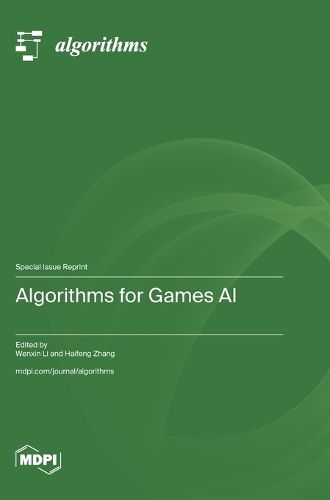
Games have long been excellent benchmarks for AI algorithms for two reasons. Initially, games are developed to assess and challenge human intelligence, and the variety of games can provide a rich context for evaluating different cognitive and decision-making abilities. Secondly, addressing complex real-world challenges often requires repeated trial and error, which can be very costly. Games offer a low-cost or even zero-cost platform for validating various algorithms and solutions by simulating or emulating real-world scenarios. Algorithms initially developed for gaming are subsequently applied to various real-world problems, generating social benefits across all aspects of life. This Special Issue, entitled "Algorithms for Game AI", explores new and innovative approaches for addressing challenges in game AI. These approaches range from traditional algorithms like planning and searching to modern algorithms such as deep reinforcement learning. The papers in this Special Issue address both the theoretical and practical challenges of the application of these algorithms. This reprint presents eleven papers covering a wide range of game AI topics, including the quantification of non-transitivity in chess, the expressiveness of level generators in Super Mario Bros, Mahjong as a new game AI benchmark, new MARL algorithms to reduce Q-value bias, surveys of various AI algorithms in cyber defense, energy areas and games, the application of MCTS in Amazons, the application of deep reinforcement learning in autonomous vehicle driving, and the application of transformers in both offline RL and imitation learning.
$9.00 standard shipping within Australia
FREE standard shipping within Australia for orders over $100.00
Express & International shipping calculated at checkout
Stock availability can be subject to change without notice. We recommend calling the shop or contacting our online team to check availability of low stock items. Please see our Shopping Online page for more details.
This title is printed to order. This book may have been self-published. If so, we cannot guarantee the quality of the content. In the main most books will have gone through the editing process however some may not. We therefore suggest that you be aware of this before ordering this book. If in doubt check either the author or publisher’s details as we are unable to accept any returns unless they are faulty. Please contact us if you have any questions.
Games have long been excellent benchmarks for AI algorithms for two reasons. Initially, games are developed to assess and challenge human intelligence, and the variety of games can provide a rich context for evaluating different cognitive and decision-making abilities. Secondly, addressing complex real-world challenges often requires repeated trial and error, which can be very costly. Games offer a low-cost or even zero-cost platform for validating various algorithms and solutions by simulating or emulating real-world scenarios. Algorithms initially developed for gaming are subsequently applied to various real-world problems, generating social benefits across all aspects of life. This Special Issue, entitled "Algorithms for Game AI", explores new and innovative approaches for addressing challenges in game AI. These approaches range from traditional algorithms like planning and searching to modern algorithms such as deep reinforcement learning. The papers in this Special Issue address both the theoretical and practical challenges of the application of these algorithms. This reprint presents eleven papers covering a wide range of game AI topics, including the quantification of non-transitivity in chess, the expressiveness of level generators in Super Mario Bros, Mahjong as a new game AI benchmark, new MARL algorithms to reduce Q-value bias, surveys of various AI algorithms in cyber defense, energy areas and games, the application of MCTS in Amazons, the application of deep reinforcement learning in autonomous vehicle driving, and the application of transformers in both offline RL and imitation learning.
Search our extensive online catalogue.
