Readings Newsletter
Become a Readings Member to make your shopping experience even easier.
Sign in or sign up for free!
You’re not far away from qualifying for FREE standard shipping within Australia
You’ve qualified for FREE standard shipping within Australia
The cart is loading…


This title is printed to order. This book may have been self-published. If so, we cannot guarantee the quality of the content. In the main most books will have gone through the editing process however some may not. We therefore suggest that you be aware of this before ordering this book. If in doubt check either the author or publisher’s details as we are unable to accept any returns unless they are faulty. Please contact us if you have any questions.
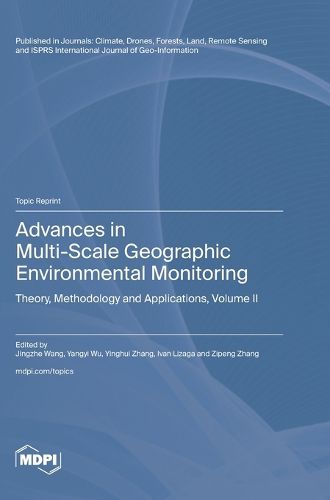
The geographic environment, shaped by climate, landforms, hydrological processes, and anthropogenic influences, demands integrated approaches to capture its spatiotemporal heterogeneity and interconnected dynamics. Recent innovations-spanning remote sensing, geospatial big data, sensor networks, and multidisciplinary modeling-now enable multidimensional, multiscale observations across extended temporal and spatial ranges. These technologies facilitate the integration of data from global to microscale levels, enhancing our understanding of geographic processes and their implications for sustainable development. The following Topic compiles 44 peer-reviewed articles that exemplify cutting-edge methodologies and applications in this field. Studies employ diverse techniques, from satellite- and drone-based remote sensing to hybrid data fusion and machine learning, demonstrating the interdisciplinary nature of geographic environmental research. Key findings highlight the value of multiscale data integration in unraveling complex patterns. By integrating Earth system science with societal needs, this research trajectory aims to strengthen resilience to environmental risks and advance the United Nations Sustainable Development Goals (SDGs). This Topic underscores the transformative potential of multi-scale monitoring in deciphering geographic complexity, offering a foundation for interdisciplinary innovation and holistic environmental stewardship in an era of rapid global change.
$9.00 standard shipping within Australia
FREE standard shipping within Australia for orders over $100.00
Express & International shipping calculated at checkout
Stock availability can be subject to change without notice. We recommend calling the shop or contacting our online team to check availability of low stock items. Please see our Shopping Online page for more details.
This title is printed to order. This book may have been self-published. If so, we cannot guarantee the quality of the content. In the main most books will have gone through the editing process however some may not. We therefore suggest that you be aware of this before ordering this book. If in doubt check either the author or publisher’s details as we are unable to accept any returns unless they are faulty. Please contact us if you have any questions.
The geographic environment, shaped by climate, landforms, hydrological processes, and anthropogenic influences, demands integrated approaches to capture its spatiotemporal heterogeneity and interconnected dynamics. Recent innovations-spanning remote sensing, geospatial big data, sensor networks, and multidisciplinary modeling-now enable multidimensional, multiscale observations across extended temporal and spatial ranges. These technologies facilitate the integration of data from global to microscale levels, enhancing our understanding of geographic processes and their implications for sustainable development. The following Topic compiles 44 peer-reviewed articles that exemplify cutting-edge methodologies and applications in this field. Studies employ diverse techniques, from satellite- and drone-based remote sensing to hybrid data fusion and machine learning, demonstrating the interdisciplinary nature of geographic environmental research. Key findings highlight the value of multiscale data integration in unraveling complex patterns. By integrating Earth system science with societal needs, this research trajectory aims to strengthen resilience to environmental risks and advance the United Nations Sustainable Development Goals (SDGs). This Topic underscores the transformative potential of multi-scale monitoring in deciphering geographic complexity, offering a foundation for interdisciplinary innovation and holistic environmental stewardship in an era of rapid global change.
Search our extensive online catalogue.
