Readings Newsletter
Become a Readings Member to make your shopping experience even easier.
Sign in or sign up for free!
You’re not far away from qualifying for FREE standard shipping within Australia
You’ve qualified for FREE standard shipping within Australia
The cart is loading…


This title is printed to order. This book may have been self-published. If so, we cannot guarantee the quality of the content. In the main most books will have gone through the editing process however some may not. We therefore suggest that you be aware of this before ordering this book. If in doubt check either the author or publisher’s details as we are unable to accept any returns unless they are faulty. Please contact us if you have any questions.
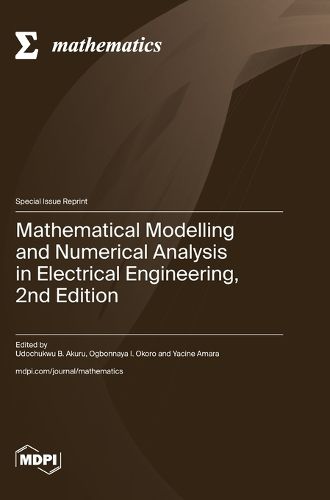
The Second Edition of this Special Issue book, titled "Mathematical Modelling and Numerical Analysis in Electrical Engineering, 2nd Edition", builds upon the success of the first edition published in August 2024. It continues to showcase cutting-edge applications of mathematical modelling and numerical analysis in electrical engineering. This edition comprises ten papers, demonstrating significant advancements across key research themes aligned with the objectives of the Special Issue. A feature paper by Hoang et al. presents an innovative rotational speed sensor based on FSM technology for superior and accurate speed measurement applications. Hoang et al. then applied harmonic modelling on eddy-current speed sensors. Garmut et al. present research on optimisation of IPMSM BLDC drives with neural network modelling. Cha at al. contribute a high-efficiency external rotor IPMSM using GPM and optimisation techniques. Nguyen et al.'s two studies employed subdomain modelling for the rapid analysis of WRSC and optimisation of a coaxial magnetic gear. Onokwai et al. implemented a combined metaheuristic algorithm with RSM to optimise GTPP performance. Baier et al. applied mathematical modelling on CSIs for grid-connected systems. Brezovnik et al. and Rahmanovic et al. advanced mathematical approximation techniques for the fast analytical calculation of a spot-welding system and the comparative modelling of NO steel materials using Bezier curves, respectively.
$9.00 standard shipping within Australia
FREE standard shipping within Australia for orders over $100.00
Express & International shipping calculated at checkout
Stock availability can be subject to change without notice. We recommend calling the shop or contacting our online team to check availability of low stock items. Please see our Shopping Online page for more details.
This title is printed to order. This book may have been self-published. If so, we cannot guarantee the quality of the content. In the main most books will have gone through the editing process however some may not. We therefore suggest that you be aware of this before ordering this book. If in doubt check either the author or publisher’s details as we are unable to accept any returns unless they are faulty. Please contact us if you have any questions.
The Second Edition of this Special Issue book, titled "Mathematical Modelling and Numerical Analysis in Electrical Engineering, 2nd Edition", builds upon the success of the first edition published in August 2024. It continues to showcase cutting-edge applications of mathematical modelling and numerical analysis in electrical engineering. This edition comprises ten papers, demonstrating significant advancements across key research themes aligned with the objectives of the Special Issue. A feature paper by Hoang et al. presents an innovative rotational speed sensor based on FSM technology for superior and accurate speed measurement applications. Hoang et al. then applied harmonic modelling on eddy-current speed sensors. Garmut et al. present research on optimisation of IPMSM BLDC drives with neural network modelling. Cha at al. contribute a high-efficiency external rotor IPMSM using GPM and optimisation techniques. Nguyen et al.'s two studies employed subdomain modelling for the rapid analysis of WRSC and optimisation of a coaxial magnetic gear. Onokwai et al. implemented a combined metaheuristic algorithm with RSM to optimise GTPP performance. Baier et al. applied mathematical modelling on CSIs for grid-connected systems. Brezovnik et al. and Rahmanovic et al. advanced mathematical approximation techniques for the fast analytical calculation of a spot-welding system and the comparative modelling of NO steel materials using Bezier curves, respectively.
Search our extensive online catalogue.
