Readings Newsletter
Become a Readings Member to make your shopping experience even easier.
Sign in or sign up for free!
You’re not far away from qualifying for FREE standard shipping within Australia
You’ve qualified for FREE standard shipping within Australia
The cart is loading…


This title is printed to order. This book may have been self-published. If so, we cannot guarantee the quality of the content. In the main most books will have gone through the editing process however some may not. We therefore suggest that you be aware of this before ordering this book. If in doubt check either the author or publisher’s details as we are unable to accept any returns unless they are faulty. Please contact us if you have any questions.
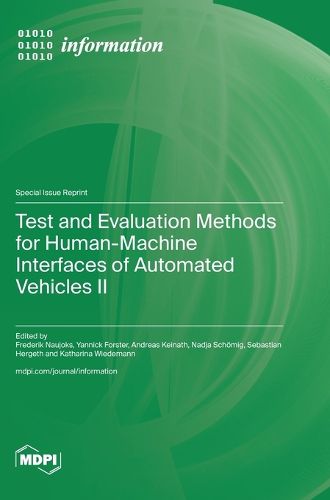
With the introduction of automated driving systems (ADSs) and advanced driver assistance systems, the communication of the driver's responsibilities and the AD's capabilities has become an important topic in recent years. For example, partially automated driving (SAE L2) systems need to be able to communicate that the driver is still fully responsible for driving safety, whereas higher levels of vehicle automation need to be able to communicate that the driver has to act as a fallback-ready user in case of system limits and malfunctions (SAE L3). During the same trip, different levels of automation might be available to the driver, making it even more crucial that the driving mode is efficiently displayed. These developments require new, standardized tests and evaluating methods for in-vehicle Human-Machine Interfaces (HMIs). This Special Issue includes theoretical papers as well as empirical studies that propose new and innovative test methods in the evaluation of ADS HMIs.
$9.00 standard shipping within Australia
FREE standard shipping within Australia for orders over $100.00
Express & International shipping calculated at checkout
Stock availability can be subject to change without notice. We recommend calling the shop or contacting our online team to check availability of low stock items. Please see our Shopping Online page for more details.
This title is printed to order. This book may have been self-published. If so, we cannot guarantee the quality of the content. In the main most books will have gone through the editing process however some may not. We therefore suggest that you be aware of this before ordering this book. If in doubt check either the author or publisher’s details as we are unable to accept any returns unless they are faulty. Please contact us if you have any questions.
With the introduction of automated driving systems (ADSs) and advanced driver assistance systems, the communication of the driver's responsibilities and the AD's capabilities has become an important topic in recent years. For example, partially automated driving (SAE L2) systems need to be able to communicate that the driver is still fully responsible for driving safety, whereas higher levels of vehicle automation need to be able to communicate that the driver has to act as a fallback-ready user in case of system limits and malfunctions (SAE L3). During the same trip, different levels of automation might be available to the driver, making it even more crucial that the driving mode is efficiently displayed. These developments require new, standardized tests and evaluating methods for in-vehicle Human-Machine Interfaces (HMIs). This Special Issue includes theoretical papers as well as empirical studies that propose new and innovative test methods in the evaluation of ADS HMIs.
Search our extensive online catalogue.
