Readings Newsletter
Become a Readings Member to make your shopping experience even easier.
Sign in or sign up for free!
You’re not far away from qualifying for FREE standard shipping within Australia
You’ve qualified for FREE standard shipping within Australia
The cart is loading…


This title is printed to order. This book may have been self-published. If so, we cannot guarantee the quality of the content. In the main most books will have gone through the editing process however some may not. We therefore suggest that you be aware of this before ordering this book. If in doubt check either the author or publisher’s details as we are unable to accept any returns unless they are faulty. Please contact us if you have any questions.
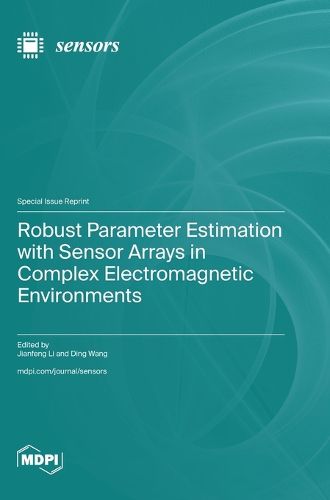
Sensor arrays have been widely applied in various fields, e.g., wireless communication, radar, and navigation. Key roles of sensor arrays include providing spatial parameter estimations and enhancing parameter estimation performances in other domains. However, with the present complex electromagnetic environment, general estimation methods experience significant performance degradations when encountering complex signal propagation, such as multipath or occlusion situations. Meanwhile, a sensor array system itself also suffers from uncertainties, such as gain-phase errors and mutual coupling, which are classic but long-term problems. In this Special Issue, we have collected a range of representative research works on this topic. In response to errors in the sensor array itself, such as random array deformations and mutual coupling, sparse array design and small-aperture antenna design methods are proposed. Meanwhile, from a parameter estimation perspective, conformal maps, element selection, and deep learning-based methods are proposed. In response to the received data errors caused by complex environments, such as multipath propagation and low signal-to-noise ratios, methods based on reweighted sparse sensing, pseudo noise resampling, Bayesian estimation, and multiphase filters are proposed. Furthermore, in response to the high complexity brought by robust processing algorithms, methods such as Taylor Compensation and dimensionality reduction are proposed. The relevant methods have shown excellent performance under complex system errors through simulation tests or actual tests.
$9.00 standard shipping within Australia
FREE standard shipping within Australia for orders over $100.00
Express & International shipping calculated at checkout
Stock availability can be subject to change without notice. We recommend calling the shop or contacting our online team to check availability of low stock items. Please see our Shopping Online page for more details.
This title is printed to order. This book may have been self-published. If so, we cannot guarantee the quality of the content. In the main most books will have gone through the editing process however some may not. We therefore suggest that you be aware of this before ordering this book. If in doubt check either the author or publisher’s details as we are unable to accept any returns unless they are faulty. Please contact us if you have any questions.
Sensor arrays have been widely applied in various fields, e.g., wireless communication, radar, and navigation. Key roles of sensor arrays include providing spatial parameter estimations and enhancing parameter estimation performances in other domains. However, with the present complex electromagnetic environment, general estimation methods experience significant performance degradations when encountering complex signal propagation, such as multipath or occlusion situations. Meanwhile, a sensor array system itself also suffers from uncertainties, such as gain-phase errors and mutual coupling, which are classic but long-term problems. In this Special Issue, we have collected a range of representative research works on this topic. In response to errors in the sensor array itself, such as random array deformations and mutual coupling, sparse array design and small-aperture antenna design methods are proposed. Meanwhile, from a parameter estimation perspective, conformal maps, element selection, and deep learning-based methods are proposed. In response to the received data errors caused by complex environments, such as multipath propagation and low signal-to-noise ratios, methods based on reweighted sparse sensing, pseudo noise resampling, Bayesian estimation, and multiphase filters are proposed. Furthermore, in response to the high complexity brought by robust processing algorithms, methods such as Taylor Compensation and dimensionality reduction are proposed. The relevant methods have shown excellent performance under complex system errors through simulation tests or actual tests.
Search our extensive online catalogue.
