Readings Newsletter
Become a Readings Member to make your shopping experience even easier.
Sign in or sign up for free!
You’re not far away from qualifying for FREE standard shipping within Australia
You’ve qualified for FREE standard shipping within Australia
The cart is loading…


This title is printed to order. This book may have been self-published. If so, we cannot guarantee the quality of the content. In the main most books will have gone through the editing process however some may not. We therefore suggest that you be aware of this before ordering this book. If in doubt check either the author or publisher’s details as we are unable to accept any returns unless they are faulty. Please contact us if you have any questions.
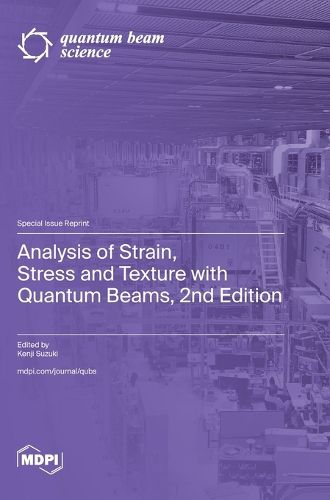
Quantum beams refer to neutrons and synchrotron radiation, and the facilities that use them are not familiar research methods. However, the micro-beams with high-brightness and high-energy X-rays have their penetrating power. The quantum beam has excellent capabilities for evaluating materials. Japan has the neutron facilities J-PARC and JRR-3, and the synchrotron radiation facility SPring-8. This reprint contains research articles that used these representative facilities in Japan. Specifically, it summarizes the latest research results on stress, strain, and texture using synchrotron radiation and neutrons in Japan. From of the perspective of materials, the works in this reprint cover a wide range of topics, not only including common metallic materials, but also coarse grains, welding materials, superconducting materials, construction materials, thermal barrier coatings, and composite materials. Measurement methods are based on diffraction. In terms of methodology, the time-of-flight method using neutrons, the double exposure method using synchrotron radiation suitable for coarse grains, the extended 3DXRD, and the constant penetration depth method are also included in this reprint. Numerical simulation techniques move into the mainstream in the evaluation of stress-strain of materials. However, when stress, strain, and texture are measured, the results of the numerical calculations differ from reality. As the saying goes, "seeing is believing"; science cannot advance with numerical calculations alone. By reading each of these papers, you should be able to find clues to solving the problems you are facing.
$9.00 standard shipping within Australia
FREE standard shipping within Australia for orders over $100.00
Express & International shipping calculated at checkout
Stock availability can be subject to change without notice. We recommend calling the shop or contacting our online team to check availability of low stock items. Please see our Shopping Online page for more details.
This title is printed to order. This book may have been self-published. If so, we cannot guarantee the quality of the content. In the main most books will have gone through the editing process however some may not. We therefore suggest that you be aware of this before ordering this book. If in doubt check either the author or publisher’s details as we are unable to accept any returns unless they are faulty. Please contact us if you have any questions.
Quantum beams refer to neutrons and synchrotron radiation, and the facilities that use them are not familiar research methods. However, the micro-beams with high-brightness and high-energy X-rays have their penetrating power. The quantum beam has excellent capabilities for evaluating materials. Japan has the neutron facilities J-PARC and JRR-3, and the synchrotron radiation facility SPring-8. This reprint contains research articles that used these representative facilities in Japan. Specifically, it summarizes the latest research results on stress, strain, and texture using synchrotron radiation and neutrons in Japan. From of the perspective of materials, the works in this reprint cover a wide range of topics, not only including common metallic materials, but also coarse grains, welding materials, superconducting materials, construction materials, thermal barrier coatings, and composite materials. Measurement methods are based on diffraction. In terms of methodology, the time-of-flight method using neutrons, the double exposure method using synchrotron radiation suitable for coarse grains, the extended 3DXRD, and the constant penetration depth method are also included in this reprint. Numerical simulation techniques move into the mainstream in the evaluation of stress-strain of materials. However, when stress, strain, and texture are measured, the results of the numerical calculations differ from reality. As the saying goes, "seeing is believing"; science cannot advance with numerical calculations alone. By reading each of these papers, you should be able to find clues to solving the problems you are facing.
Search our extensive online catalogue.
