Readings Newsletter
Become a Readings Member to make your shopping experience even easier.
Sign in or sign up for free!
You’re not far away from qualifying for FREE standard shipping within Australia
You’ve qualified for FREE standard shipping within Australia
The cart is loading…


This title is printed to order. This book may have been self-published. If so, we cannot guarantee the quality of the content. In the main most books will have gone through the editing process however some may not. We therefore suggest that you be aware of this before ordering this book. If in doubt check either the author or publisher’s details as we are unable to accept any returns unless they are faulty. Please contact us if you have any questions.
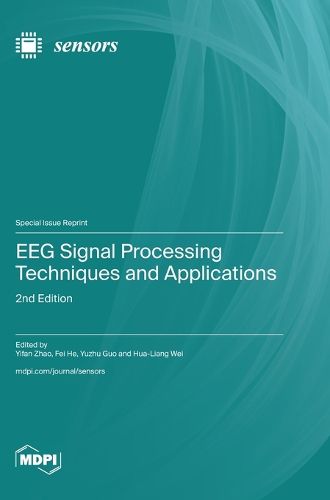
Electroencephalography (EEG) is a well-established non-invasive tool used to record brain electrophysiological activity. It is economical, portable, easy to administer, and widely available in most hospitals. Compared with other neuroimaging techniques that provide information about the anatomical structure (e.g., MRI, CT, and fMRI), EEG offers ultra-high time resolution, which is critical in understanding brain function. Empirical interpretation of EEG is largely based on recognizing abnormal frequencies in specific biological states, the spatial-temporal and morphological characteristics of paroxysmal or persistent discharges, reactivity to external stimuli and activation procedures, or intermittent photic stimulation. Despite being useful in many instances, these practical approaches to interpreting EEGs can leave important dynamic and nonlinear interactions between various brain network anatomical constituents undetected within the recordings, as such interactions are far beyond the observational capabilities of any specially trained physician in this field. This reprint provides a collection of original high-quality research in EEG signal pre-processing, modelling, analysis, and applications in the time, space, frequency, or time-frequency domains, particularly in applications of artificial intelligence and machine learning approaches.
$9.00 standard shipping within Australia
FREE standard shipping within Australia for orders over $100.00
Express & International shipping calculated at checkout
Stock availability can be subject to change without notice. We recommend calling the shop or contacting our online team to check availability of low stock items. Please see our Shopping Online page for more details.
This title is printed to order. This book may have been self-published. If so, we cannot guarantee the quality of the content. In the main most books will have gone through the editing process however some may not. We therefore suggest that you be aware of this before ordering this book. If in doubt check either the author or publisher’s details as we are unable to accept any returns unless they are faulty. Please contact us if you have any questions.
Electroencephalography (EEG) is a well-established non-invasive tool used to record brain electrophysiological activity. It is economical, portable, easy to administer, and widely available in most hospitals. Compared with other neuroimaging techniques that provide information about the anatomical structure (e.g., MRI, CT, and fMRI), EEG offers ultra-high time resolution, which is critical in understanding brain function. Empirical interpretation of EEG is largely based on recognizing abnormal frequencies in specific biological states, the spatial-temporal and morphological characteristics of paroxysmal or persistent discharges, reactivity to external stimuli and activation procedures, or intermittent photic stimulation. Despite being useful in many instances, these practical approaches to interpreting EEGs can leave important dynamic and nonlinear interactions between various brain network anatomical constituents undetected within the recordings, as such interactions are far beyond the observational capabilities of any specially trained physician in this field. This reprint provides a collection of original high-quality research in EEG signal pre-processing, modelling, analysis, and applications in the time, space, frequency, or time-frequency domains, particularly in applications of artificial intelligence and machine learning approaches.
Search our extensive online catalogue.
