Readings Newsletter
Become a Readings Member to make your shopping experience even easier.
Sign in or sign up for free!
You’re not far away from qualifying for FREE standard shipping within Australia
You’ve qualified for FREE standard shipping within Australia
The cart is loading…


This title is printed to order. This book may have been self-published. If so, we cannot guarantee the quality of the content. In the main most books will have gone through the editing process however some may not. We therefore suggest that you be aware of this before ordering this book. If in doubt check either the author or publisher’s details as we are unable to accept any returns unless they are faulty. Please contact us if you have any questions.
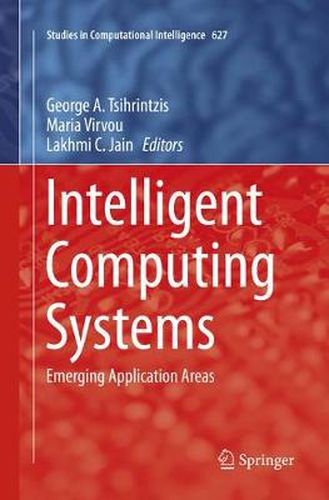
This book at hand explores emerging scientific and technological areas in which Intelligent Computing Systems provide efficient solutions and, thus, may play a role in the years to come. It demonstrates how Intelligent Computing Systems make use of computational methodologies that mimic nature-inspired processes to address real world problems of high complexity for which exact mathematical solutions, based on physical and statistical modelling, are intractable. Common intelligent computational methodologies are presented including artificial neural networks, evolutionary computation, genetic algorithms, artificial immune systems, fuzzy logic, swarm intelligence, artificial life, virtual worlds and hybrid methodologies based on combinations of the previous.
The book will be useful to researchers, practitioners and graduate students dealing with mathematically-intractable problems. It is intended for both the expert/researcher in the field of Intelligent Computing Systems, as well as for the general reader in the fields of Artificial and Computational Intelligence who wishes to learn more about the field of Intelligent Computing Systems and its applications. An extensive list of bibliographic references at the end of each chapter guides the reader to probe further into application area of interest to him/her.
$9.00 standard shipping within Australia
FREE standard shipping within Australia for orders over $100.00
Express & International shipping calculated at checkout
Stock availability can be subject to change without notice. We recommend calling the shop or contacting our online team to check availability of low stock items. Please see our Shopping Online page for more details.
This title is printed to order. This book may have been self-published. If so, we cannot guarantee the quality of the content. In the main most books will have gone through the editing process however some may not. We therefore suggest that you be aware of this before ordering this book. If in doubt check either the author or publisher’s details as we are unable to accept any returns unless they are faulty. Please contact us if you have any questions.
This book at hand explores emerging scientific and technological areas in which Intelligent Computing Systems provide efficient solutions and, thus, may play a role in the years to come. It demonstrates how Intelligent Computing Systems make use of computational methodologies that mimic nature-inspired processes to address real world problems of high complexity for which exact mathematical solutions, based on physical and statistical modelling, are intractable. Common intelligent computational methodologies are presented including artificial neural networks, evolutionary computation, genetic algorithms, artificial immune systems, fuzzy logic, swarm intelligence, artificial life, virtual worlds and hybrid methodologies based on combinations of the previous.
The book will be useful to researchers, practitioners and graduate students dealing with mathematically-intractable problems. It is intended for both the expert/researcher in the field of Intelligent Computing Systems, as well as for the general reader in the fields of Artificial and Computational Intelligence who wishes to learn more about the field of Intelligent Computing Systems and its applications. An extensive list of bibliographic references at the end of each chapter guides the reader to probe further into application area of interest to him/her.
Search our extensive online catalogue.
