Readings Newsletter
Become a Readings Member to make your shopping experience even easier.
Sign in or sign up for free!
You’re not far away from qualifying for FREE standard shipping within Australia
You’ve qualified for FREE standard shipping within Australia
The cart is loading…


This title is printed to order. This book may have been self-published. If so, we cannot guarantee the quality of the content. In the main most books will have gone through the editing process however some may not. We therefore suggest that you be aware of this before ordering this book. If in doubt check either the author or publisher’s details as we are unable to accept any returns unless they are faulty. Please contact us if you have any questions.
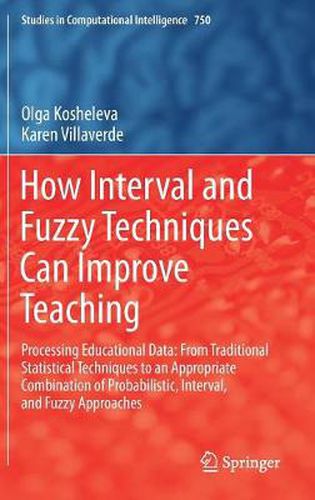
This book explains how to teach better and presents the latest research on processing educational data and presents traditional statistical techniques as well as probabilistic, interval, and fuzzy approaches. Teaching is a very rewarding activity; it is also a very difficult one - because it is largely an art. There is a lot of advice on teaching available, but it is usually informal and is not easy to follow. To remedy this situation, it is reasonable to use techniques specifically designed to handle such imprecise knowledge: the fuzzy logic techniques.
Since there are a large number of statistical studies of different teaching techniques, the authors combined statistical and fuzzy approaches to process the educational data in order to provide insights into improving all the stages of the education process: from forming a curriculum to deciding in which order to present the material to grading the assignments and exams.
The authors do not claim to have solved all the problems of education. Instead they show, using numerous examples, that an innovative combination of different uncertainty techniques can improve teaching. The book offers teachers and instructors valuable advice and provides researchers in pedagogical and fuzzy areas with techniques to further advance teaching.
$9.00 standard shipping within Australia
FREE standard shipping within Australia for orders over $100.00
Express & International shipping calculated at checkout
Stock availability can be subject to change without notice. We recommend calling the shop or contacting our online team to check availability of low stock items. Please see our Shopping Online page for more details.
This title is printed to order. This book may have been self-published. If so, we cannot guarantee the quality of the content. In the main most books will have gone through the editing process however some may not. We therefore suggest that you be aware of this before ordering this book. If in doubt check either the author or publisher’s details as we are unable to accept any returns unless they are faulty. Please contact us if you have any questions.
This book explains how to teach better and presents the latest research on processing educational data and presents traditional statistical techniques as well as probabilistic, interval, and fuzzy approaches. Teaching is a very rewarding activity; it is also a very difficult one - because it is largely an art. There is a lot of advice on teaching available, but it is usually informal and is not easy to follow. To remedy this situation, it is reasonable to use techniques specifically designed to handle such imprecise knowledge: the fuzzy logic techniques.
Since there are a large number of statistical studies of different teaching techniques, the authors combined statistical and fuzzy approaches to process the educational data in order to provide insights into improving all the stages of the education process: from forming a curriculum to deciding in which order to present the material to grading the assignments and exams.
The authors do not claim to have solved all the problems of education. Instead they show, using numerous examples, that an innovative combination of different uncertainty techniques can improve teaching. The book offers teachers and instructors valuable advice and provides researchers in pedagogical and fuzzy areas with techniques to further advance teaching.
Search our extensive online catalogue.
