Readings Newsletter
Become a Readings Member to make your shopping experience even easier.
Sign in or sign up for free!
You’re not far away from qualifying for FREE standard shipping within Australia
You’ve qualified for FREE standard shipping within Australia
The cart is loading…


This title is printed to order. This book may have been self-published. If so, we cannot guarantee the quality of the content. In the main most books will have gone through the editing process however some may not. We therefore suggest that you be aware of this before ordering this book. If in doubt check either the author or publisher’s details as we are unable to accept any returns unless they are faulty. Please contact us if you have any questions.
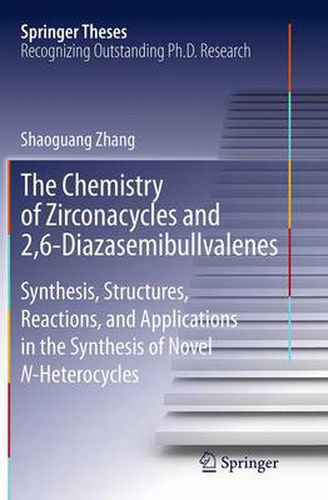
In this thesis, the author introduces two strategies used to construct various types of N-heterocycles, based on the chemistry of zirconacycles and 2,6-diazasemibullvalenes. In the first part, the author presents the development of multi-component cyclization of a zirconacyclobutene-silacyclobutene fused compound, nitriles and unsaturated compounds. These reactions provide synthetically useful methodology for various N-heterocycles such as 3-acyl pyrrole, pyrrolo[3,2-d]pyridazine and dihydropyrroloazepine, which are all difficult to synthesize by other means. The isolation and characterization of the key three-fused-ring Zr/Si-containing intermediates are also described in detail. These results show that the zirconacyclobutene-silacyclobutene fused compound behaves as a chemical transformer upon treatment with various substrates via the coordination-induced skeleton rearrangement mechanism. In the second part, the author demonstrates the synthesis and isolation of a series of 2,6-diazasemibullvalenes (NSBVs) from the reaction of 1,4-dilithio-1,3-dienes and nitriles, highlighting the significant progress made for the first time in this work: (1) determination of X-ray crystal structure of a substituted 2,6-diazasemibullvalene; (2) measurement of the activation barrier of its rapid intramolecular aza-Cope rearrangement in solution; (3) exploration of several reaction types of NSBV with diverse ring-expansion products and bowl-shape or cage-shape N-containing polycyclic skeletons; (4) demonstration of the localized structure as the predominant form and the homoaromatic delocalized structure as a minor component in the equilibrium using theoretical analysis. Based on well-founded results, this work sheds new light on this controversial topic.
$9.00 standard shipping within Australia
FREE standard shipping within Australia for orders over $100.00
Express & International shipping calculated at checkout
Stock availability can be subject to change without notice. We recommend calling the shop or contacting our online team to check availability of low stock items. Please see our Shopping Online page for more details.
This title is printed to order. This book may have been self-published. If so, we cannot guarantee the quality of the content. In the main most books will have gone through the editing process however some may not. We therefore suggest that you be aware of this before ordering this book. If in doubt check either the author or publisher’s details as we are unable to accept any returns unless they are faulty. Please contact us if you have any questions.
In this thesis, the author introduces two strategies used to construct various types of N-heterocycles, based on the chemistry of zirconacycles and 2,6-diazasemibullvalenes. In the first part, the author presents the development of multi-component cyclization of a zirconacyclobutene-silacyclobutene fused compound, nitriles and unsaturated compounds. These reactions provide synthetically useful methodology for various N-heterocycles such as 3-acyl pyrrole, pyrrolo[3,2-d]pyridazine and dihydropyrroloazepine, which are all difficult to synthesize by other means. The isolation and characterization of the key three-fused-ring Zr/Si-containing intermediates are also described in detail. These results show that the zirconacyclobutene-silacyclobutene fused compound behaves as a chemical transformer upon treatment with various substrates via the coordination-induced skeleton rearrangement mechanism. In the second part, the author demonstrates the synthesis and isolation of a series of 2,6-diazasemibullvalenes (NSBVs) from the reaction of 1,4-dilithio-1,3-dienes and nitriles, highlighting the significant progress made for the first time in this work: (1) determination of X-ray crystal structure of a substituted 2,6-diazasemibullvalene; (2) measurement of the activation barrier of its rapid intramolecular aza-Cope rearrangement in solution; (3) exploration of several reaction types of NSBV with diverse ring-expansion products and bowl-shape or cage-shape N-containing polycyclic skeletons; (4) demonstration of the localized structure as the predominant form and the homoaromatic delocalized structure as a minor component in the equilibrium using theoretical analysis. Based on well-founded results, this work sheds new light on this controversial topic.
Search our extensive online catalogue.
