Readings Newsletter
Become a Readings Member to make your shopping experience even easier.
Sign in or sign up for free!
You’re not far away from qualifying for FREE standard shipping within Australia
You’ve qualified for FREE standard shipping within Australia
The cart is loading…


This title is printed to order. This book may have been self-published. If so, we cannot guarantee the quality of the content. In the main most books will have gone through the editing process however some may not. We therefore suggest that you be aware of this before ordering this book. If in doubt check either the author or publisher’s details as we are unable to accept any returns unless they are faulty. Please contact us if you have any questions.
Distinguishing chaoticity from regularity in deterministic dynamical systems and specifying the subspace of the phase space in which instabilities are expected to occur is of utmost importance in as disparate areas as astronomy, particle physics and climate dynamics.
To address these issues there exists a plethora of methods for chaos detection and predictability. The most commonly employed technique for investigating chaotic dynamics, i.e. the computation of Lyapunov exponents, however, may suffer a number of problems and drawbacks, for example when applied to noisy experimental data.
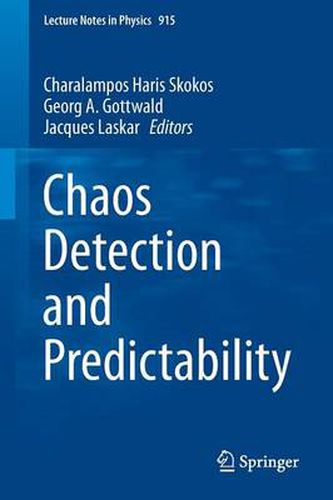
In the last two decades, several novel methods have been developed for the fast and reliable determination of the regular or chaotic nature of orbits, aimed at overcoming the shortcomings of more traditional techniques. This set of lecture notes and tutorial reviews serves as an introduction to and overview of modern chaos detection and predictability techniques for graduate students and non-specialists.
The book covers theoretical and computational aspects of traditional methods to calculate Lyapunov exponents, as well as of modern techniques like the Fast (FLI), the Orthogonal (OFLI) and the Relative (RLI) Lyapunov Indicators, the Mean Exponential Growth factor of Nearby Orbits (MEGNO), the Smaller (SALI) and the Generalized (GALI) Alignment Index and the ‘0-1’ test for chaos.
$9.00 standard shipping within Australia
FREE standard shipping within Australia for orders over $100.00
Express & International shipping calculated at checkout
Stock availability can be subject to change without notice. We recommend calling the shop or contacting our online team to check availability of low stock items. Please see our Shopping Online page for more details.
This title is printed to order. This book may have been self-published. If so, we cannot guarantee the quality of the content. In the main most books will have gone through the editing process however some may not. We therefore suggest that you be aware of this before ordering this book. If in doubt check either the author or publisher’s details as we are unable to accept any returns unless they are faulty. Please contact us if you have any questions.
Distinguishing chaoticity from regularity in deterministic dynamical systems and specifying the subspace of the phase space in which instabilities are expected to occur is of utmost importance in as disparate areas as astronomy, particle physics and climate dynamics.
To address these issues there exists a plethora of methods for chaos detection and predictability. The most commonly employed technique for investigating chaotic dynamics, i.e. the computation of Lyapunov exponents, however, may suffer a number of problems and drawbacks, for example when applied to noisy experimental data.
In the last two decades, several novel methods have been developed for the fast and reliable determination of the regular or chaotic nature of orbits, aimed at overcoming the shortcomings of more traditional techniques. This set of lecture notes and tutorial reviews serves as an introduction to and overview of modern chaos detection and predictability techniques for graduate students and non-specialists.
The book covers theoretical and computational aspects of traditional methods to calculate Lyapunov exponents, as well as of modern techniques like the Fast (FLI), the Orthogonal (OFLI) and the Relative (RLI) Lyapunov Indicators, the Mean Exponential Growth factor of Nearby Orbits (MEGNO), the Smaller (SALI) and the Generalized (GALI) Alignment Index and the ‘0-1’ test for chaos.
Search our extensive online catalogue.
