Readings Newsletter
Become a Readings Member to make your shopping experience even easier.
Sign in or sign up for free!
You’re not far away from qualifying for FREE standard shipping within Australia
You’ve qualified for FREE standard shipping within Australia
The cart is loading…


This title is printed to order. This book may have been self-published. If so, we cannot guarantee the quality of the content. In the main most books will have gone through the editing process however some may not. We therefore suggest that you be aware of this before ordering this book. If in doubt check either the author or publisher’s details as we are unable to accept any returns unless they are faulty. Please contact us if you have any questions.
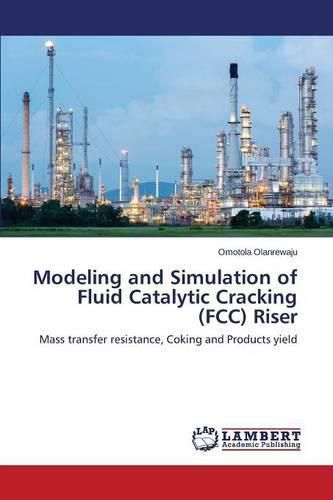
Fluid Catalytic Cracking (FCC) is known to be one of the most profitable processes in oil refineries. However, during FCC, two inevitable and undesirable phenomena occur: coking (which deactivates the catalyst) and resistance to mass transfer.Computational techniques can be employed to simulate the FCC reactor with a view to predicting the optimum operating conditions of the process. Process operation within the optimum conditions increases profitability. A number of mathematical models have been developed for the FCC riser. However, two major set backs were observed in the models. Some of the previous models were oversimplified as a result of the negligence of mass transfer resistance and the assumption of one dimensional (1D) plug flow. On the other hand, the models were made unwieldy by the use of 3D geometry and the incorporation of large numbers of lumped species. In this book, a 2D model was used to simulate the FCC riser. Mass transfer resistance and coking were considered. This book will be beneficial to oil refineries. It will also make an excellent reference and teaching material for students, lecturers and researchers in Chemical Engineering, Mathematics and Chemistry
$9.00 standard shipping within Australia
FREE standard shipping within Australia for orders over $100.00
Express & International shipping calculated at checkout
Stock availability can be subject to change without notice. We recommend calling the shop or contacting our online team to check availability of low stock items. Please see our Shopping Online page for more details.
This title is printed to order. This book may have been self-published. If so, we cannot guarantee the quality of the content. In the main most books will have gone through the editing process however some may not. We therefore suggest that you be aware of this before ordering this book. If in doubt check either the author or publisher’s details as we are unable to accept any returns unless they are faulty. Please contact us if you have any questions.
Fluid Catalytic Cracking (FCC) is known to be one of the most profitable processes in oil refineries. However, during FCC, two inevitable and undesirable phenomena occur: coking (which deactivates the catalyst) and resistance to mass transfer.Computational techniques can be employed to simulate the FCC reactor with a view to predicting the optimum operating conditions of the process. Process operation within the optimum conditions increases profitability. A number of mathematical models have been developed for the FCC riser. However, two major set backs were observed in the models. Some of the previous models were oversimplified as a result of the negligence of mass transfer resistance and the assumption of one dimensional (1D) plug flow. On the other hand, the models were made unwieldy by the use of 3D geometry and the incorporation of large numbers of lumped species. In this book, a 2D model was used to simulate the FCC riser. Mass transfer resistance and coking were considered. This book will be beneficial to oil refineries. It will also make an excellent reference and teaching material for students, lecturers and researchers in Chemical Engineering, Mathematics and Chemistry
Search our extensive online catalogue.
