Readings Newsletter
Become a Readings Member to make your shopping experience even easier.
Sign in or sign up for free!
You’re not far away from qualifying for FREE standard shipping within Australia
You’ve qualified for FREE standard shipping within Australia
The cart is loading…


This title is printed to order. This book may have been self-published. If so, we cannot guarantee the quality of the content. In the main most books will have gone through the editing process however some may not. We therefore suggest that you be aware of this before ordering this book. If in doubt check either the author or publisher’s details as we are unable to accept any returns unless they are faulty. Please contact us if you have any questions.
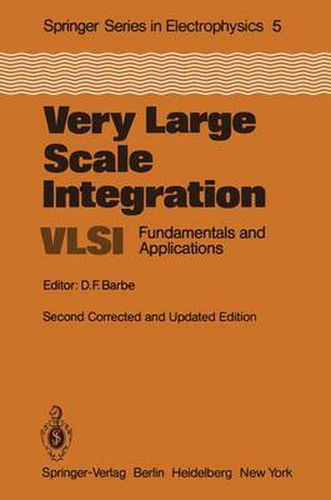
Even elementary school students of today know that electronics can do fan tastic things. Electronic calculators make arithmetic easy. An electronic box connected to your TV set provides a wonderful array of games. Electronic boxes can translate languages! Electronics has even changed watches from a pair of hands to a set of digits. Integrated circuit (IC) chips, which use transistors to store information in binary form and perform binary arithmetic, make all of this possible. In just a short twenty years, the field of inte grated circuits has progressed from chips containing several transistors performing simple functions such as OR and AND functions to chips presently available which contain thousands of transistors performing a wide range of memory, control and arithmetic functions. In the late 1970’s Very Large Scale Integration (VLSI) caught the imagin ation of the industrialized world. The United States, Japan and other coun tries now have substantial efforts to push the frontier of microelectronics across the one-micrometer barrier and into sub-micrometer features. The achievement of this goal will have tremendous impl ications, both technolo gical and economic for the countries involved.
$9.00 standard shipping within Australia
FREE standard shipping within Australia for orders over $100.00
Express & International shipping calculated at checkout
Stock availability can be subject to change without notice. We recommend calling the shop or contacting our online team to check availability of low stock items. Please see our Shopping Online page for more details.
This title is printed to order. This book may have been self-published. If so, we cannot guarantee the quality of the content. In the main most books will have gone through the editing process however some may not. We therefore suggest that you be aware of this before ordering this book. If in doubt check either the author or publisher’s details as we are unable to accept any returns unless they are faulty. Please contact us if you have any questions.
Even elementary school students of today know that electronics can do fan tastic things. Electronic calculators make arithmetic easy. An electronic box connected to your TV set provides a wonderful array of games. Electronic boxes can translate languages! Electronics has even changed watches from a pair of hands to a set of digits. Integrated circuit (IC) chips, which use transistors to store information in binary form and perform binary arithmetic, make all of this possible. In just a short twenty years, the field of inte grated circuits has progressed from chips containing several transistors performing simple functions such as OR and AND functions to chips presently available which contain thousands of transistors performing a wide range of memory, control and arithmetic functions. In the late 1970’s Very Large Scale Integration (VLSI) caught the imagin ation of the industrialized world. The United States, Japan and other coun tries now have substantial efforts to push the frontier of microelectronics across the one-micrometer barrier and into sub-micrometer features. The achievement of this goal will have tremendous impl ications, both technolo gical and economic for the countries involved.
Search our extensive online catalogue.
