Readings Newsletter
Become a Readings Member to make your shopping experience even easier.
Sign in or sign up for free!
You’re not far away from qualifying for FREE standard shipping within Australia
You’ve qualified for FREE standard shipping within Australia
The cart is loading…


This title is printed to order. This book may have been self-published. If so, we cannot guarantee the quality of the content. In the main most books will have gone through the editing process however some may not. We therefore suggest that you be aware of this before ordering this book. If in doubt check either the author or publisher’s details as we are unable to accept any returns unless they are faulty. Please contact us if you have any questions.
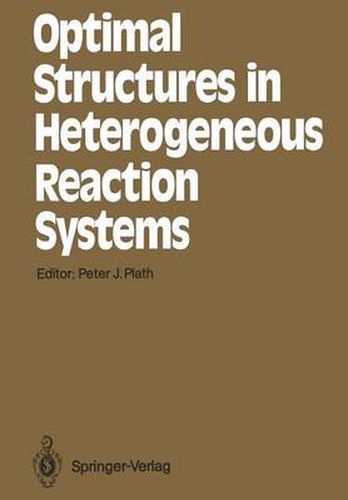
The concept of this book was developed during the Winter Seminar held in the Austrian mountains at the Alpengasthof Zeinisjoch, Tirol-Vorarlberg, from February 27 to March 3, 1988. Leading experts and advanced students in math ematics, physics, chemistry and computer science met to present and discuss their most recent results in an informal seminar. These were the circumstances that led to the idea of compiling some of the essential contributions presented at this seminar together with others describing basic features of optimal struc tures in heterogeneous reaction systems . The aim of this book is to present the scientific results of the intensive work carried out in each of the specific fields of research. Each contribution therefore presents the current state of the art together with a deeper treatment enabling a more comprehensive understanding of that particular field of work. The common ideas which unite all the different contributions are already ex pressed in the title of this book. The nature of heterogeneous reaction systems is quite varied. An example is provided by the chemical systems such as noble metal particles which may act as heterogeneous catalysts for gaseous chemical compounds. Under these circumstances the metal particles and/or their sur faces may undergo phase transitions during reaction. Imbihl and Plath report on special catalytic systems of this kind, which are of industrial importance.
$9.00 standard shipping within Australia
FREE standard shipping within Australia for orders over $100.00
Express & International shipping calculated at checkout
Stock availability can be subject to change without notice. We recommend calling the shop or contacting our online team to check availability of low stock items. Please see our Shopping Online page for more details.
This title is printed to order. This book may have been self-published. If so, we cannot guarantee the quality of the content. In the main most books will have gone through the editing process however some may not. We therefore suggest that you be aware of this before ordering this book. If in doubt check either the author or publisher’s details as we are unable to accept any returns unless they are faulty. Please contact us if you have any questions.
The concept of this book was developed during the Winter Seminar held in the Austrian mountains at the Alpengasthof Zeinisjoch, Tirol-Vorarlberg, from February 27 to March 3, 1988. Leading experts and advanced students in math ematics, physics, chemistry and computer science met to present and discuss their most recent results in an informal seminar. These were the circumstances that led to the idea of compiling some of the essential contributions presented at this seminar together with others describing basic features of optimal struc tures in heterogeneous reaction systems . The aim of this book is to present the scientific results of the intensive work carried out in each of the specific fields of research. Each contribution therefore presents the current state of the art together with a deeper treatment enabling a more comprehensive understanding of that particular field of work. The common ideas which unite all the different contributions are already ex pressed in the title of this book. The nature of heterogeneous reaction systems is quite varied. An example is provided by the chemical systems such as noble metal particles which may act as heterogeneous catalysts for gaseous chemical compounds. Under these circumstances the metal particles and/or their sur faces may undergo phase transitions during reaction. Imbihl and Plath report on special catalytic systems of this kind, which are of industrial importance.
Search our extensive online catalogue.
