Readings Newsletter
Become a Readings Member to make your shopping experience even easier.
Sign in or sign up for free!
You’re not far away from qualifying for FREE standard shipping within Australia
You’ve qualified for FREE standard shipping within Australia
The cart is loading…


This title is printed to order. This book may have been self-published. If so, we cannot guarantee the quality of the content. In the main most books will have gone through the editing process however some may not. We therefore suggest that you be aware of this before ordering this book. If in doubt check either the author or publisher’s details as we are unable to accept any returns unless they are faulty. Please contact us if you have any questions.
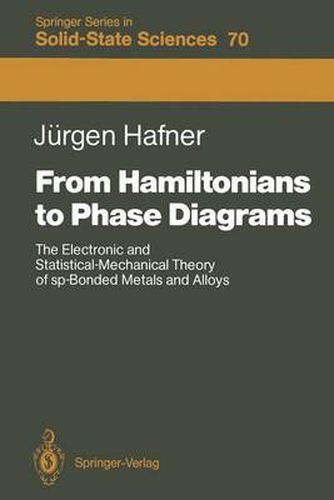
The development of the modern theory of metals and alloys has coincided with great advances in quantum-mechanical many-body theory, in electronic structure calculations, in theories of lattice dynamics and of the configura tional thermodynamics of crystals, in liquid-state theory, and in the theory of phase transformations. For a long time all these different fields expanded quite independently, but now their overlap has become sufficiently large that they are beginning to form the basis of a comprehensive first-principles the ory of the cohesive, structural, and thermodynamical properties of metals and alloys in the crystalline as well as in the liquid state. Today, we can set out from the quantum-mechanical many-body Hamiltonian of the system of electrons and ions, and, following the path laid out by generations of the oreticians, we can progress far enough to calculate a pressure-temperature phase diagram of a metal or a composition-temperature phase diagram of a binary alloy by methods which are essentially rigorous and from first prin ciples. This book was written with the intention of confronting the materials scientist, the metallurgist, the physical chemist, but also the experimen tal and theoretical condensed-matter physicist, with this new and exciting possibility. Of course there are limitations to such a vast undertaking as this. The selection of the theories and techniques to be discussed, as well as the way in which they are presented, are necessarily biased by personal inclination and personal expertise.
$9.00 standard shipping within Australia
FREE standard shipping within Australia for orders over $100.00
Express & International shipping calculated at checkout
Stock availability can be subject to change without notice. We recommend calling the shop or contacting our online team to check availability of low stock items. Please see our Shopping Online page for more details.
This title is printed to order. This book may have been self-published. If so, we cannot guarantee the quality of the content. In the main most books will have gone through the editing process however some may not. We therefore suggest that you be aware of this before ordering this book. If in doubt check either the author or publisher’s details as we are unable to accept any returns unless they are faulty. Please contact us if you have any questions.
The development of the modern theory of metals and alloys has coincided with great advances in quantum-mechanical many-body theory, in electronic structure calculations, in theories of lattice dynamics and of the configura tional thermodynamics of crystals, in liquid-state theory, and in the theory of phase transformations. For a long time all these different fields expanded quite independently, but now their overlap has become sufficiently large that they are beginning to form the basis of a comprehensive first-principles the ory of the cohesive, structural, and thermodynamical properties of metals and alloys in the crystalline as well as in the liquid state. Today, we can set out from the quantum-mechanical many-body Hamiltonian of the system of electrons and ions, and, following the path laid out by generations of the oreticians, we can progress far enough to calculate a pressure-temperature phase diagram of a metal or a composition-temperature phase diagram of a binary alloy by methods which are essentially rigorous and from first prin ciples. This book was written with the intention of confronting the materials scientist, the metallurgist, the physical chemist, but also the experimen tal and theoretical condensed-matter physicist, with this new and exciting possibility. Of course there are limitations to such a vast undertaking as this. The selection of the theories and techniques to be discussed, as well as the way in which they are presented, are necessarily biased by personal inclination and personal expertise.
Search our extensive online catalogue.
