Readings Newsletter
Become a Readings Member to make your shopping experience even easier.
Sign in or sign up for free!
You’re not far away from qualifying for FREE standard shipping within Australia
You’ve qualified for FREE standard shipping within Australia
The cart is loading…


This title is printed to order. This book may have been self-published. If so, we cannot guarantee the quality of the content. In the main most books will have gone through the editing process however some may not. We therefore suggest that you be aware of this before ordering this book. If in doubt check either the author or publisher’s details as we are unable to accept any returns unless they are faulty. Please contact us if you have any questions.
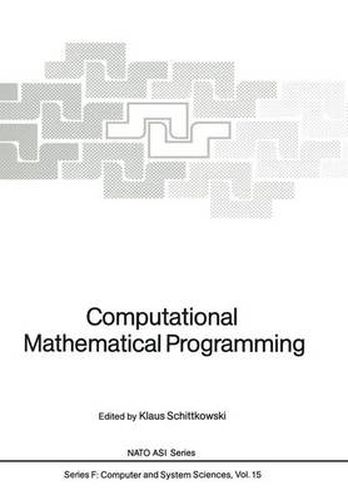
This book contains the written versions of main lectures presented at the Advanced Study Institute (ASI) on Computational Mathematical Programming, which was held in Bad Windsheim, Germany F. R., from July 23 to August 2, 1984, under the sponsorship of NATO. The ASI was organized by the Committee on Algorithms (COAL) of the Mathematical Programming Society. Co-directors were Karla Hoffmann (National Bureau of Standards, Washington, U.S.A.) and Jan Teigen (Rabobank Nederland, Zeist, The Netherlands). Ninety participants coming from about 20 different countries attended the ASI and contributed their efforts to achieve a highly interesting and stimulating meeting. Since 1947 when the first linear programming technique was developed, the importance of optimization models and their mathematical solution methods has steadily increased, and now plays a leading role in applied research areas. The basic idea of optimization theory is to minimize (or maximize) a function of several variables subject to certain restrictions. This general mathematical concept covers a broad class of possible practical applications arising in mechanical, electrical, or chemical engineering, physics, economics, medicine, biology, etc. There are both industrial applications (e.g. design of mechanical structures, production plans) and applications in the natural, engineering, and social sciences (e.g. chemical equilibrium problems, christollography problems).
$9.00 standard shipping within Australia
FREE standard shipping within Australia for orders over $100.00
Express & International shipping calculated at checkout
Stock availability can be subject to change without notice. We recommend calling the shop or contacting our online team to check availability of low stock items. Please see our Shopping Online page for more details.
This title is printed to order. This book may have been self-published. If so, we cannot guarantee the quality of the content. In the main most books will have gone through the editing process however some may not. We therefore suggest that you be aware of this before ordering this book. If in doubt check either the author or publisher’s details as we are unable to accept any returns unless they are faulty. Please contact us if you have any questions.
This book contains the written versions of main lectures presented at the Advanced Study Institute (ASI) on Computational Mathematical Programming, which was held in Bad Windsheim, Germany F. R., from July 23 to August 2, 1984, under the sponsorship of NATO. The ASI was organized by the Committee on Algorithms (COAL) of the Mathematical Programming Society. Co-directors were Karla Hoffmann (National Bureau of Standards, Washington, U.S.A.) and Jan Teigen (Rabobank Nederland, Zeist, The Netherlands). Ninety participants coming from about 20 different countries attended the ASI and contributed their efforts to achieve a highly interesting and stimulating meeting. Since 1947 when the first linear programming technique was developed, the importance of optimization models and their mathematical solution methods has steadily increased, and now plays a leading role in applied research areas. The basic idea of optimization theory is to minimize (or maximize) a function of several variables subject to certain restrictions. This general mathematical concept covers a broad class of possible practical applications arising in mechanical, electrical, or chemical engineering, physics, economics, medicine, biology, etc. There are both industrial applications (e.g. design of mechanical structures, production plans) and applications in the natural, engineering, and social sciences (e.g. chemical equilibrium problems, christollography problems).
Search our extensive online catalogue.
