Readings Newsletter
Become a Readings Member to make your shopping experience even easier.
Sign in or sign up for free!
You’re not far away from qualifying for FREE standard shipping within Australia
You’ve qualified for FREE standard shipping within Australia
The cart is loading…


This title is printed to order. This book may have been self-published. If so, we cannot guarantee the quality of the content. In the main most books will have gone through the editing process however some may not. We therefore suggest that you be aware of this before ordering this book. If in doubt check either the author or publisher’s details as we are unable to accept any returns unless they are faulty. Please contact us if you have any questions.
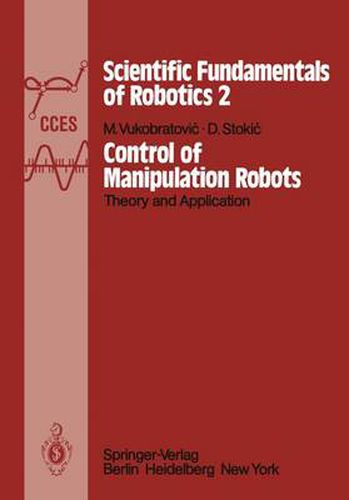
This monograph represents the second book of the series entitled: SCI ENTIFIC FUNDAl-1ENTALS OF ROBOTICS . While the first volume provides a study of the dynamics of spatial mechanisms and its application to the design of these mechanisms, the present one focuses on the synthesis -of control based~n the knowledge of dynamic models (presented in de tail in the first_ volume). In this way a logical continuity is formed in which one may easily recognize a dynamic approach to the design of manipulation r-obots and the synthesis of control algorithms based on exact mathematical models of dynamics of open spatial mechanisms. When writing the monograph, the authors had the following objective: to prove that a study of dynamic properties of manipulation mechanisms is justifiable, to use the dynamic properties in the synthesis of con trol algorithms, and to determine, from one case to another, a proper measure of dynamics depending on the type of manipulation task, the v$!locity at which it is carried out, and on the type of the manipu- tion mechanisms itself. The authors believe they have thus made the study of dynamics,‘ aimed at synthesizing algorithms for dynamic con trol, free from unnecessary academicism and allowed the readers to apply all the results presented here to practical purposes of manipu lator design in thfil broader sense of the word. At this point, the au thors would like to present some concepts which were their guidelines in preparing this text.
$9.00 standard shipping within Australia
FREE standard shipping within Australia for orders over $100.00
Express & International shipping calculated at checkout
Stock availability can be subject to change without notice. We recommend calling the shop or contacting our online team to check availability of low stock items. Please see our Shopping Online page for more details.
This title is printed to order. This book may have been self-published. If so, we cannot guarantee the quality of the content. In the main most books will have gone through the editing process however some may not. We therefore suggest that you be aware of this before ordering this book. If in doubt check either the author or publisher’s details as we are unable to accept any returns unless they are faulty. Please contact us if you have any questions.
This monograph represents the second book of the series entitled: SCI ENTIFIC FUNDAl-1ENTALS OF ROBOTICS . While the first volume provides a study of the dynamics of spatial mechanisms and its application to the design of these mechanisms, the present one focuses on the synthesis -of control based~n the knowledge of dynamic models (presented in de tail in the first_ volume). In this way a logical continuity is formed in which one may easily recognize a dynamic approach to the design of manipulation r-obots and the synthesis of control algorithms based on exact mathematical models of dynamics of open spatial mechanisms. When writing the monograph, the authors had the following objective: to prove that a study of dynamic properties of manipulation mechanisms is justifiable, to use the dynamic properties in the synthesis of con trol algorithms, and to determine, from one case to another, a proper measure of dynamics depending on the type of manipulation task, the v$!locity at which it is carried out, and on the type of the manipu- tion mechanisms itself. The authors believe they have thus made the study of dynamics,‘ aimed at synthesizing algorithms for dynamic con trol, free from unnecessary academicism and allowed the readers to apply all the results presented here to practical purposes of manipu lator design in thfil broader sense of the word. At this point, the au thors would like to present some concepts which were their guidelines in preparing this text.
Search our extensive online catalogue.
