Readings Newsletter
Become a Readings Member to make your shopping experience even easier.
Sign in or sign up for free!
You’re not far away from qualifying for FREE standard shipping within Australia
You’ve qualified for FREE standard shipping within Australia
The cart is loading…


This title is printed to order. This book may have been self-published. If so, we cannot guarantee the quality of the content. In the main most books will have gone through the editing process however some may not. We therefore suggest that you be aware of this before ordering this book. If in doubt check either the author or publisher’s details as we are unable to accept any returns unless they are faulty. Please contact us if you have any questions.
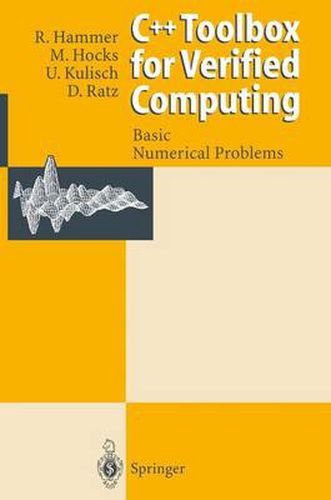
Our aim in writing this book was to provide an extensive set of C++ programs for solving basic numerical problems with verification of the results. This C++ Toolbox for Verified Computing I is the C++ edition of the Numerical Toolbox for Verified Computing l. The programs of the original edition were written in PASCAL-XSC, a PASCAL eXtension for Scientific Computation. Since we published the first edition we have received many requests from readers and users of our tools for a version in C++. We take the view that C++ is growing in importance in the field of numeri cal computing. C++ includes C, but as a typed language and due to its modern concepts, it is superior to C. To obtain the degree of efficiency that PASCAL-XSC provides, we used the C-XSC library. C-XSC is a C++ class library for eXtended Scientific Computing. C++ and the C-XSC library are an adequate alternative to special XSC-Ianguages such as PASCAL-XSC or ACRITH-XSC. A shareware version of the C-XSC library and the sources of the toolbox programs are freely available via anonymous ftp or can be ordered against reimbursement of expenses. The programs of this book do not require a great deal of insight into the features of C++. Particularly, object oriented programming techniques are not required.
$9.00 standard shipping within Australia
FREE standard shipping within Australia for orders over $100.00
Express & International shipping calculated at checkout
Stock availability can be subject to change without notice. We recommend calling the shop or contacting our online team to check availability of low stock items. Please see our Shopping Online page for more details.
This title is printed to order. This book may have been self-published. If so, we cannot guarantee the quality of the content. In the main most books will have gone through the editing process however some may not. We therefore suggest that you be aware of this before ordering this book. If in doubt check either the author or publisher’s details as we are unable to accept any returns unless they are faulty. Please contact us if you have any questions.
Our aim in writing this book was to provide an extensive set of C++ programs for solving basic numerical problems with verification of the results. This C++ Toolbox for Verified Computing I is the C++ edition of the Numerical Toolbox for Verified Computing l. The programs of the original edition were written in PASCAL-XSC, a PASCAL eXtension for Scientific Computation. Since we published the first edition we have received many requests from readers and users of our tools for a version in C++. We take the view that C++ is growing in importance in the field of numeri cal computing. C++ includes C, but as a typed language and due to its modern concepts, it is superior to C. To obtain the degree of efficiency that PASCAL-XSC provides, we used the C-XSC library. C-XSC is a C++ class library for eXtended Scientific Computing. C++ and the C-XSC library are an adequate alternative to special XSC-Ianguages such as PASCAL-XSC or ACRITH-XSC. A shareware version of the C-XSC library and the sources of the toolbox programs are freely available via anonymous ftp or can be ordered against reimbursement of expenses. The programs of this book do not require a great deal of insight into the features of C++. Particularly, object oriented programming techniques are not required.
Search our extensive online catalogue.
