Readings Newsletter
Become a Readings Member to make your shopping experience even easier.
Sign in or sign up for free!
You’re not far away from qualifying for FREE standard shipping within Australia
You’ve qualified for FREE standard shipping within Australia
The cart is loading…


This title is printed to order. This book may have been self-published. If so, we cannot guarantee the quality of the content. In the main most books will have gone through the editing process however some may not. We therefore suggest that you be aware of this before ordering this book. If in doubt check either the author or publisher’s details as we are unable to accept any returns unless they are faulty. Please contact us if you have any questions.
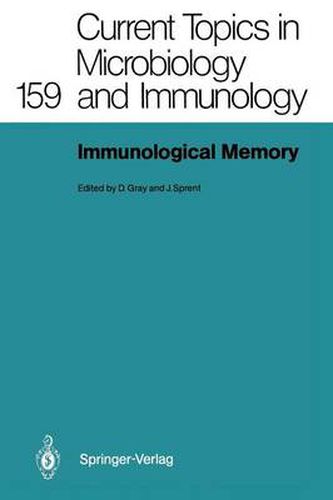
Although immunologists know rather a lot about the manif estation of immunological memory, an understanding of the mechanism of memory at cellular and biochemical levels eludes us. Indeed, as we shall see, it is not even clear which of the several models used to explain the working of memory approximates to the truth. It is in order to report on approaches to this problem and on recent experimental advances in the field of memory cells that this volume has been put together. In the past 4-5 years cell surface molecules that may enable us to define memory Band T cells have been identified. It may now be possible to ask how memory cells are generated and to define what signals are required during or after antigenic encounter for a cell to enter the memory cell pool rather than to terminally differentiate into an effector cell. The transition from virgin cell to memory cell is clearly accompanied by several biochemical changes. For B cells, isotype switching and somatic mutations (leading to affinity maturation) are well-defined phenomena, although the molecular mechanisms remain mys terious. Both have received attention in many excellent reviews of late and so are not considered in detail in this book. Neither switching nor somatic mutation is a feature of peripheral T-cell maturation; biochemical differences between virgin and mem ory T cells may only relate to differing activation requirements and possibly changes in the expression of accessory molecules.
$9.00 standard shipping within Australia
FREE standard shipping within Australia for orders over $100.00
Express & International shipping calculated at checkout
Stock availability can be subject to change without notice. We recommend calling the shop or contacting our online team to check availability of low stock items. Please see our Shopping Online page for more details.
This title is printed to order. This book may have been self-published. If so, we cannot guarantee the quality of the content. In the main most books will have gone through the editing process however some may not. We therefore suggest that you be aware of this before ordering this book. If in doubt check either the author or publisher’s details as we are unable to accept any returns unless they are faulty. Please contact us if you have any questions.
Although immunologists know rather a lot about the manif estation of immunological memory, an understanding of the mechanism of memory at cellular and biochemical levels eludes us. Indeed, as we shall see, it is not even clear which of the several models used to explain the working of memory approximates to the truth. It is in order to report on approaches to this problem and on recent experimental advances in the field of memory cells that this volume has been put together. In the past 4-5 years cell surface molecules that may enable us to define memory Band T cells have been identified. It may now be possible to ask how memory cells are generated and to define what signals are required during or after antigenic encounter for a cell to enter the memory cell pool rather than to terminally differentiate into an effector cell. The transition from virgin cell to memory cell is clearly accompanied by several biochemical changes. For B cells, isotype switching and somatic mutations (leading to affinity maturation) are well-defined phenomena, although the molecular mechanisms remain mys terious. Both have received attention in many excellent reviews of late and so are not considered in detail in this book. Neither switching nor somatic mutation is a feature of peripheral T-cell maturation; biochemical differences between virgin and mem ory T cells may only relate to differing activation requirements and possibly changes in the expression of accessory molecules.
Search our extensive online catalogue.
