Readings Newsletter
Become a Readings Member to make your shopping experience even easier.
Sign in or sign up for free!
You’re not far away from qualifying for FREE standard shipping within Australia
You’ve qualified for FREE standard shipping within Australia
The cart is loading…


This title is printed to order. This book may have been self-published. If so, we cannot guarantee the quality of the content. In the main most books will have gone through the editing process however some may not. We therefore suggest that you be aware of this before ordering this book. If in doubt check either the author or publisher’s details as we are unable to accept any returns unless they are faulty. Please contact us if you have any questions.
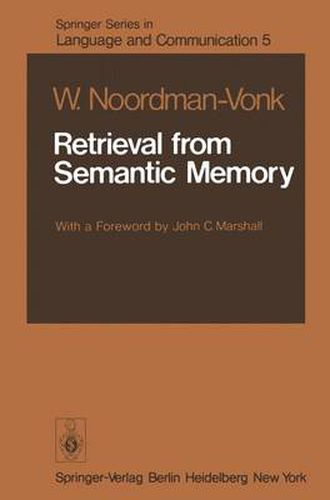
The area of concern to Dr. Wietske Noordman~Vonk has been variously seen as an aspect of long-term memory [F. I], secondary memory [F. 2], memory without record [F. 3], and semantic memory [F. 4J, the latter term being the one pre ferred by Dr. Noordman-Vonk herself. This proliferation of terminology is not an entirely trivial matter, for although the expressions clearly overlap in range, they do draw attention to different features of the phenomena under consideration. The work reported here is concerned with the form of representation and manipulation of our knowledge that, for example, a dog is an animal, or that mothers and daughters are parents and children. To put it more generally, the experiments attempt to elucidate the psychological processes involved in the~emantics of class-inclusion and, most importantly, to extend the explanatory principles there invoked to a new domain, that of kinship relations. Clearly, the connections between ant and insect , or flower and plant have been known to us - as adults - for some considerable period of time; in the absence of brain injury or degeneration we are unlikely to forget that fathers and sons are kin of the same sex. We may therefor- pretheoretically - distinguish between retrieval of such knowledge and. re trieval of a rapidly fading sequence of random numbers that we are asked to recall after a single presentation. It is in this sense that the current work is concerned with long-term and not short-term memory.
$9.00 standard shipping within Australia
FREE standard shipping within Australia for orders over $100.00
Express & International shipping calculated at checkout
Stock availability can be subject to change without notice. We recommend calling the shop or contacting our online team to check availability of low stock items. Please see our Shopping Online page for more details.
This title is printed to order. This book may have been self-published. If so, we cannot guarantee the quality of the content. In the main most books will have gone through the editing process however some may not. We therefore suggest that you be aware of this before ordering this book. If in doubt check either the author or publisher’s details as we are unable to accept any returns unless they are faulty. Please contact us if you have any questions.
The area of concern to Dr. Wietske Noordman~Vonk has been variously seen as an aspect of long-term memory [F. I], secondary memory [F. 2], memory without record [F. 3], and semantic memory [F. 4J, the latter term being the one pre ferred by Dr. Noordman-Vonk herself. This proliferation of terminology is not an entirely trivial matter, for although the expressions clearly overlap in range, they do draw attention to different features of the phenomena under consideration. The work reported here is concerned with the form of representation and manipulation of our knowledge that, for example, a dog is an animal, or that mothers and daughters are parents and children. To put it more generally, the experiments attempt to elucidate the psychological processes involved in the~emantics of class-inclusion and, most importantly, to extend the explanatory principles there invoked to a new domain, that of kinship relations. Clearly, the connections between ant and insect , or flower and plant have been known to us - as adults - for some considerable period of time; in the absence of brain injury or degeneration we are unlikely to forget that fathers and sons are kin of the same sex. We may therefor- pretheoretically - distinguish between retrieval of such knowledge and. re trieval of a rapidly fading sequence of random numbers that we are asked to recall after a single presentation. It is in this sense that the current work is concerned with long-term and not short-term memory.
Search our extensive online catalogue.
