Readings Newsletter
Become a Readings Member to make your shopping experience even easier.
Sign in or sign up for free!
You’re not far away from qualifying for FREE standard shipping within Australia
You’ve qualified for FREE standard shipping within Australia
The cart is loading…


This title is printed to order. This book may have been self-published. If so, we cannot guarantee the quality of the content. In the main most books will have gone through the editing process however some may not. We therefore suggest that you be aware of this before ordering this book. If in doubt check either the author or publisher’s details as we are unable to accept any returns unless they are faulty. Please contact us if you have any questions.
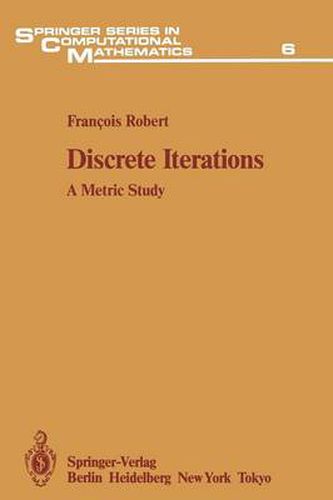
a c 9 h In presenting this monograph, I would like to indicate both its orientation as well as my personal reasons for being interested in discrete iterations (that is, iterations on a generally very large,jinite set). While working in numerical analysis I have been interested in two main aspects: - the algorithmic aspect: an iterative algorithm is a mathematical entity which behaves in a dynamic fashion. Even if it is started far from a solution, it will often tend to get closer and closer. - the mathematical aspect: this consists of a coherent and rigorous analy sis of convergence, with the aid of mathematical tools (these tools are mainly the use of norms for convergence proofs, the use of matrix algebra and so on). One may for example refer to the algorithmic and mathematical aspects of Newton’s method in JRn as well as to the QR algorithm for eigenvalues of matrices. These two algorithms seem to me to be the most fascinating algorithms in numerical analysis, since both show a remarkable practical efficiency even though there exist relatively few global convergence results for them.
$9.00 standard shipping within Australia
FREE standard shipping within Australia for orders over $100.00
Express & International shipping calculated at checkout
Stock availability can be subject to change without notice. We recommend calling the shop or contacting our online team to check availability of low stock items. Please see our Shopping Online page for more details.
This title is printed to order. This book may have been self-published. If so, we cannot guarantee the quality of the content. In the main most books will have gone through the editing process however some may not. We therefore suggest that you be aware of this before ordering this book. If in doubt check either the author or publisher’s details as we are unable to accept any returns unless they are faulty. Please contact us if you have any questions.
a c 9 h In presenting this monograph, I would like to indicate both its orientation as well as my personal reasons for being interested in discrete iterations (that is, iterations on a generally very large,jinite set). While working in numerical analysis I have been interested in two main aspects: - the algorithmic aspect: an iterative algorithm is a mathematical entity which behaves in a dynamic fashion. Even if it is started far from a solution, it will often tend to get closer and closer. - the mathematical aspect: this consists of a coherent and rigorous analy sis of convergence, with the aid of mathematical tools (these tools are mainly the use of norms for convergence proofs, the use of matrix algebra and so on). One may for example refer to the algorithmic and mathematical aspects of Newton’s method in JRn as well as to the QR algorithm for eigenvalues of matrices. These two algorithms seem to me to be the most fascinating algorithms in numerical analysis, since both show a remarkable practical efficiency even though there exist relatively few global convergence results for them.
Search our extensive online catalogue.
