Readings Newsletter
Become a Readings Member to make your shopping experience even easier.
Sign in or sign up for free!
You’re not far away from qualifying for FREE standard shipping within Australia
You’ve qualified for FREE standard shipping within Australia
The cart is loading…


This title is printed to order. This book may have been self-published. If so, we cannot guarantee the quality of the content. In the main most books will have gone through the editing process however some may not. We therefore suggest that you be aware of this before ordering this book. If in doubt check either the author or publisher’s details as we are unable to accept any returns unless they are faulty. Please contact us if you have any questions.
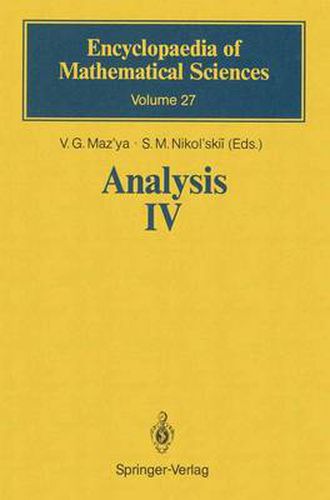
A linear integral equation is an equation of the form XEX. (1) 2a(x)cp(x) - Ix k(x, y)cp(y)dv(y) = f(x), Here (X, v) is a measure space with a-finite measure v, 2 is a complex parameter, and a, k, f are given (complex-valued) functions, which are referred to as the coefficient, the kernel, and the free term (or the right-hand side) of equation (1), respectively. The problem consists in determining the parameter 2 and the unknown function cp such that equation (1) is satisfied for almost all x E X (or even for all x E X if, for instance, the integral is understood in the sense of Riemann). In the case f = 0, the equation (1) is called homogeneous, otherwise it is called inhomogeneous. If a and k are matrix functions and, accordingly, cp and f are vector-valued functions, then (1) is referred to as a system of integral equations. Integral equations of the form (1) arise in connection with many boundary value and eigenvalue problems of mathematical physics. Three types of linear integral equations are distinguished: If 2 = 0, then (1) is called an equation of the first kind; if 2a(x) i= 0 for all x E X, then (1) is termed an equation of the second kind; and finally, if a vanishes on some subset of X but 2 i= 0, then (1) is said to be of the third kind.
$9.00 standard shipping within Australia
FREE standard shipping within Australia for orders over $100.00
Express & International shipping calculated at checkout
Stock availability can be subject to change without notice. We recommend calling the shop or contacting our online team to check availability of low stock items. Please see our Shopping Online page for more details.
This title is printed to order. This book may have been self-published. If so, we cannot guarantee the quality of the content. In the main most books will have gone through the editing process however some may not. We therefore suggest that you be aware of this before ordering this book. If in doubt check either the author or publisher’s details as we are unable to accept any returns unless they are faulty. Please contact us if you have any questions.
A linear integral equation is an equation of the form XEX. (1) 2a(x)cp(x) - Ix k(x, y)cp(y)dv(y) = f(x), Here (X, v) is a measure space with a-finite measure v, 2 is a complex parameter, and a, k, f are given (complex-valued) functions, which are referred to as the coefficient, the kernel, and the free term (or the right-hand side) of equation (1), respectively. The problem consists in determining the parameter 2 and the unknown function cp such that equation (1) is satisfied for almost all x E X (or even for all x E X if, for instance, the integral is understood in the sense of Riemann). In the case f = 0, the equation (1) is called homogeneous, otherwise it is called inhomogeneous. If a and k are matrix functions and, accordingly, cp and f are vector-valued functions, then (1) is referred to as a system of integral equations. Integral equations of the form (1) arise in connection with many boundary value and eigenvalue problems of mathematical physics. Three types of linear integral equations are distinguished: If 2 = 0, then (1) is called an equation of the first kind; if 2a(x) i= 0 for all x E X, then (1) is termed an equation of the second kind; and finally, if a vanishes on some subset of X but 2 i= 0, then (1) is said to be of the third kind.
Search our extensive online catalogue.
