Readings Newsletter
Become a Readings Member to make your shopping experience even easier.
Sign in or sign up for free!
You’re not far away from qualifying for FREE standard shipping within Australia
You’ve qualified for FREE standard shipping within Australia
The cart is loading…


This title is printed to order. This book may have been self-published. If so, we cannot guarantee the quality of the content. In the main most books will have gone through the editing process however some may not. We therefore suggest that you be aware of this before ordering this book. If in doubt check either the author or publisher’s details as we are unable to accept any returns unless they are faulty. Please contact us if you have any questions.
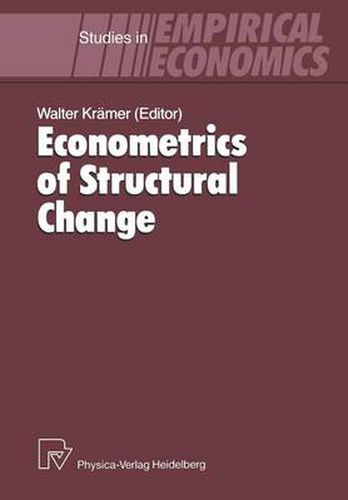
Econometric models are made up of assumptions which never exactly match reality. Among the most contested ones is the requirement that the coefficients of an econometric model remain stable over time. Recent years have therefore seen numerous attempts to test for it or to model possible structural change when it can no longer be ignored. This collection of papers from Empirical Economics mirrors part of this development. The point of departure of most studies in this volume is the standard linear regression model Yt = x;fJt + U (t = I, … , 1), t where notation is obvious and where the index t emphasises the fact that structural change is mostly discussed and encountered in a time series context. It is much less of a problem for cross section data, although many tests apply there as well. The null hypothesis of most tests for structural change is that fJt = fJo for all t, i.e. that the same regression applies to all time periods in the sample and that the disturbances u are well behaved. The well known Chow test for instance assumes t that there is a single structural shift at a known point in time, i.e. that fJt = fJo (t< t*), and fJt = fJo + t1fJ (t ?:. t*), where t* is known.
$9.00 standard shipping within Australia
FREE standard shipping within Australia for orders over $100.00
Express & International shipping calculated at checkout
Stock availability can be subject to change without notice. We recommend calling the shop or contacting our online team to check availability of low stock items. Please see our Shopping Online page for more details.
This title is printed to order. This book may have been self-published. If so, we cannot guarantee the quality of the content. In the main most books will have gone through the editing process however some may not. We therefore suggest that you be aware of this before ordering this book. If in doubt check either the author or publisher’s details as we are unable to accept any returns unless they are faulty. Please contact us if you have any questions.
Econometric models are made up of assumptions which never exactly match reality. Among the most contested ones is the requirement that the coefficients of an econometric model remain stable over time. Recent years have therefore seen numerous attempts to test for it or to model possible structural change when it can no longer be ignored. This collection of papers from Empirical Economics mirrors part of this development. The point of departure of most studies in this volume is the standard linear regression model Yt = x;fJt + U (t = I, … , 1), t where notation is obvious and where the index t emphasises the fact that structural change is mostly discussed and encountered in a time series context. It is much less of a problem for cross section data, although many tests apply there as well. The null hypothesis of most tests for structural change is that fJt = fJo for all t, i.e. that the same regression applies to all time periods in the sample and that the disturbances u are well behaved. The well known Chow test for instance assumes t that there is a single structural shift at a known point in time, i.e. that fJt = fJo (t< t*), and fJt = fJo + t1fJ (t ?:. t*), where t* is known.
Search our extensive online catalogue.
