Readings Newsletter
Become a Readings Member to make your shopping experience even easier.
Sign in or sign up for free!
You’re not far away from qualifying for FREE standard shipping within Australia
You’ve qualified for FREE standard shipping within Australia
The cart is loading…


This title is printed to order. This book may have been self-published. If so, we cannot guarantee the quality of the content. In the main most books will have gone through the editing process however some may not. We therefore suggest that you be aware of this before ordering this book. If in doubt check either the author or publisher’s details as we are unable to accept any returns unless they are faulty. Please contact us if you have any questions.
Statistics and hypothesis testing are routinely used in areas (such as linguistics) that are traditionally not mathematically intensive. In such fields, when faced with experimental data, many students and researchers tend to rely on commercial packages to carry out statistical data analysis, often without understanding the logic of the statistical tests they rely on. As a consequence, results are often misinterpreted, and users have difficulty in flexibly applying techniques relevant to their own research - they use whatever they happen to have learned. A simple solution is to teach the fundamental ideas of statistical hypothesis testing without using too much mathematics.
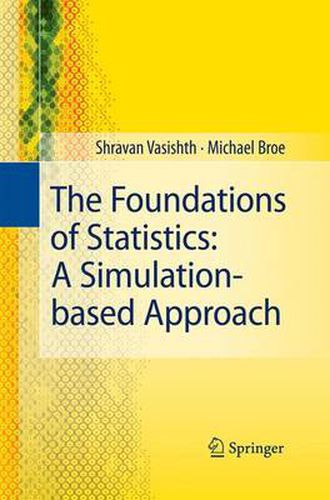
This book provides a non-mathematical, simulation-based introduction to basic statistical concepts and encourages readers to try out the simulations themselves using the source code and data provided (the freely available programming language R is used throughout). Since the code presented in the text almost always requires the use of previously introduced programming constructs, diligent students also acquire basic programming abilities in R.
The book is intended for advanced undergraduate and graduate students in any discipline, although the focus is on linguistics, psychology, and cognitive science. It is designed for self-instruction, but it can also be used as a textbook for a first course on statistics. Earlier versions of the book have been used in undergraduate and graduate courses in Europe and the US.
Vasishth and Broe have written an attractive introduction to the foundations of statistics. It is concise, surprisingly comprehensive, self-contained and yet quite accessible. Highly recommended.
Harald Baayen, Professor of Linguistics, University of Alberta, Canada
By using the text students not only learn to do the specific things outlined in the book, they also gain a skill set that empowers them to explore new areas that lie beyond the book’s coverage.
Colin Phillips, Professor of Linguistics, University of Maryland, USA
$9.00 standard shipping within Australia
FREE standard shipping within Australia for orders over $100.00
Express & International shipping calculated at checkout
Stock availability can be subject to change without notice. We recommend calling the shop or contacting our online team to check availability of low stock items. Please see our Shopping Online page for more details.
This title is printed to order. This book may have been self-published. If so, we cannot guarantee the quality of the content. In the main most books will have gone through the editing process however some may not. We therefore suggest that you be aware of this before ordering this book. If in doubt check either the author or publisher’s details as we are unable to accept any returns unless they are faulty. Please contact us if you have any questions.
Statistics and hypothesis testing are routinely used in areas (such as linguistics) that are traditionally not mathematically intensive. In such fields, when faced with experimental data, many students and researchers tend to rely on commercial packages to carry out statistical data analysis, often without understanding the logic of the statistical tests they rely on. As a consequence, results are often misinterpreted, and users have difficulty in flexibly applying techniques relevant to their own research - they use whatever they happen to have learned. A simple solution is to teach the fundamental ideas of statistical hypothesis testing without using too much mathematics.
This book provides a non-mathematical, simulation-based introduction to basic statistical concepts and encourages readers to try out the simulations themselves using the source code and data provided (the freely available programming language R is used throughout). Since the code presented in the text almost always requires the use of previously introduced programming constructs, diligent students also acquire basic programming abilities in R.
The book is intended for advanced undergraduate and graduate students in any discipline, although the focus is on linguistics, psychology, and cognitive science. It is designed for self-instruction, but it can also be used as a textbook for a first course on statistics. Earlier versions of the book have been used in undergraduate and graduate courses in Europe and the US.
Vasishth and Broe have written an attractive introduction to the foundations of statistics. It is concise, surprisingly comprehensive, self-contained and yet quite accessible. Highly recommended.
Harald Baayen, Professor of Linguistics, University of Alberta, Canada
By using the text students not only learn to do the specific things outlined in the book, they also gain a skill set that empowers them to explore new areas that lie beyond the book’s coverage.
Colin Phillips, Professor of Linguistics, University of Maryland, USA
Search our extensive online catalogue.
