Readings Newsletter
Become a Readings Member to make your shopping experience even easier.
Sign in or sign up for free!
You’re not far away from qualifying for FREE standard shipping within Australia
You’ve qualified for FREE standard shipping within Australia
The cart is loading…


This title is printed to order. This book may have been self-published. If so, we cannot guarantee the quality of the content. In the main most books will have gone through the editing process however some may not. We therefore suggest that you be aware of this before ordering this book. If in doubt check either the author or publisher’s details as we are unable to accept any returns unless they are faulty. Please contact us if you have any questions.
In the 1970s researchers noticed that radioactive particles produced by elements naturally present in packaging material could cause bits to flip in sensitive areas of electronic chips. Research into the effect of cosmic rays on semiconductors, an area of particular interest in the aerospace industry, led to methods of hardening electronic devices designed for harsh environments. Ultimately various mechanisms for fault creation and propagation were discovered, and in particular it was noted that many cryptographic algorithms succumb to so-called fault attacks.
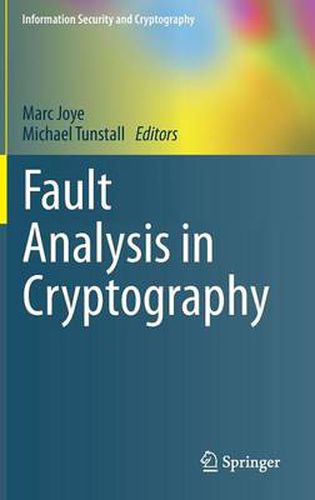
Preventing fault attacks without sacrificing performance is nontrivial and this is the subject of this book. Part I deals with side-channel analysis and its relevance to fault attacks. The chapters in Part II cover fault analysis in secret key cryptography, with chapters on block ciphers, fault analysis of DES and AES, countermeasures for symmetric-key ciphers, and countermeasures against attacks on AES. Part III deals with fault analysis in public key cryptography, with chapters dedicated to classical RSA and RSA-CRT implementations, elliptic curve cryptosystems and countermeasures using fault detection, devices resilient to fault injection attacks, lattice-based fault attacks on signatures, and fault attacks on pairing-based cryptography. Part IV examines fault attacks on stream ciphers and how faults interact with countermeasures used to prevent power analysis attacks. Finally, Part V contains chapters that explain how fault attacks are implemented, with chapters on fault injection technologies for microprocessors, and fault injection and key retrieval experiments on a widely used evaluation board.
This is the first book on this topic and will be of interest to researchers and practitioners engaged with cryptographic engineering.
$9.00 standard shipping within Australia
FREE standard shipping within Australia for orders over $100.00
Express & International shipping calculated at checkout
Stock availability can be subject to change without notice. We recommend calling the shop or contacting our online team to check availability of low stock items. Please see our Shopping Online page for more details.
This title is printed to order. This book may have been self-published. If so, we cannot guarantee the quality of the content. In the main most books will have gone through the editing process however some may not. We therefore suggest that you be aware of this before ordering this book. If in doubt check either the author or publisher’s details as we are unable to accept any returns unless they are faulty. Please contact us if you have any questions.
In the 1970s researchers noticed that radioactive particles produced by elements naturally present in packaging material could cause bits to flip in sensitive areas of electronic chips. Research into the effect of cosmic rays on semiconductors, an area of particular interest in the aerospace industry, led to methods of hardening electronic devices designed for harsh environments. Ultimately various mechanisms for fault creation and propagation were discovered, and in particular it was noted that many cryptographic algorithms succumb to so-called fault attacks.
Preventing fault attacks without sacrificing performance is nontrivial and this is the subject of this book. Part I deals with side-channel analysis and its relevance to fault attacks. The chapters in Part II cover fault analysis in secret key cryptography, with chapters on block ciphers, fault analysis of DES and AES, countermeasures for symmetric-key ciphers, and countermeasures against attacks on AES. Part III deals with fault analysis in public key cryptography, with chapters dedicated to classical RSA and RSA-CRT implementations, elliptic curve cryptosystems and countermeasures using fault detection, devices resilient to fault injection attacks, lattice-based fault attacks on signatures, and fault attacks on pairing-based cryptography. Part IV examines fault attacks on stream ciphers and how faults interact with countermeasures used to prevent power analysis attacks. Finally, Part V contains chapters that explain how fault attacks are implemented, with chapters on fault injection technologies for microprocessors, and fault injection and key retrieval experiments on a widely used evaluation board.
This is the first book on this topic and will be of interest to researchers and practitioners engaged with cryptographic engineering.
Search our extensive online catalogue.
