Readings Newsletter
Become a Readings Member to make your shopping experience even easier.
Sign in or sign up for free!
You’re not far away from qualifying for FREE standard shipping within Australia
You’ve qualified for FREE standard shipping within Australia
The cart is loading…


This title is printed to order. This book may have been self-published. If so, we cannot guarantee the quality of the content. In the main most books will have gone through the editing process however some may not. We therefore suggest that you be aware of this before ordering this book. If in doubt check either the author or publisher’s details as we are unable to accept any returns unless they are faulty. Please contact us if you have any questions.
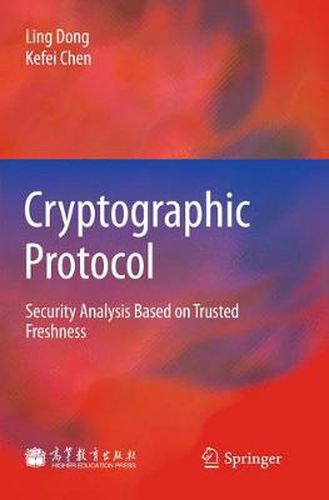
Cryptographic Protocol: Security Analysis Based on Trusted Freshness mainly discusses how to analyze and design cryptographic protocols based on the idea of system engineering and that of the trusted freshness component. A novel freshness principle based on the trusted freshness component is presented; this principle is the basis for an efficient and easy method for analyzing the security of cryptographic protocols. The reasoning results of the new approach, when compared with the security conditions, can either establish the correctness of a cryptographic protocol when the protocol is in fact correct, or identify the absence of the security properties, which leads the structure to construct attacks directly. Furthermore, based on the freshness principle, a belief multiset formalism is presented. This formalism’s efficiency, rigorousness, and the possibility of its automation are also presented. The book is intended for researchers, engineers, and graduate students in the fields of communication, computer science and cryptography, and will be especially useful for engineers who need to analyze cryptographic protocols in the real world. Dr. Ling Dong is a senior engineer in the network construction and information security field. Dr. Kefei Chen is a Professor at the Department of Computer Science and Engineering, Shanghai Jiao Tong University.
$9.00 standard shipping within Australia
FREE standard shipping within Australia for orders over $100.00
Express & International shipping calculated at checkout
Stock availability can be subject to change without notice. We recommend calling the shop or contacting our online team to check availability of low stock items. Please see our Shopping Online page for more details.
This title is printed to order. This book may have been self-published. If so, we cannot guarantee the quality of the content. In the main most books will have gone through the editing process however some may not. We therefore suggest that you be aware of this before ordering this book. If in doubt check either the author or publisher’s details as we are unable to accept any returns unless they are faulty. Please contact us if you have any questions.
Cryptographic Protocol: Security Analysis Based on Trusted Freshness mainly discusses how to analyze and design cryptographic protocols based on the idea of system engineering and that of the trusted freshness component. A novel freshness principle based on the trusted freshness component is presented; this principle is the basis for an efficient and easy method for analyzing the security of cryptographic protocols. The reasoning results of the new approach, when compared with the security conditions, can either establish the correctness of a cryptographic protocol when the protocol is in fact correct, or identify the absence of the security properties, which leads the structure to construct attacks directly. Furthermore, based on the freshness principle, a belief multiset formalism is presented. This formalism’s efficiency, rigorousness, and the possibility of its automation are also presented. The book is intended for researchers, engineers, and graduate students in the fields of communication, computer science and cryptography, and will be especially useful for engineers who need to analyze cryptographic protocols in the real world. Dr. Ling Dong is a senior engineer in the network construction and information security field. Dr. Kefei Chen is a Professor at the Department of Computer Science and Engineering, Shanghai Jiao Tong University.
Search our extensive online catalogue.
